Personal advisory board
How to build a personal board of advisors—and make it operational
Create a personal board of advisors with clear seats, meeting rhythms, decision records, human and AI members, and practical accountability.
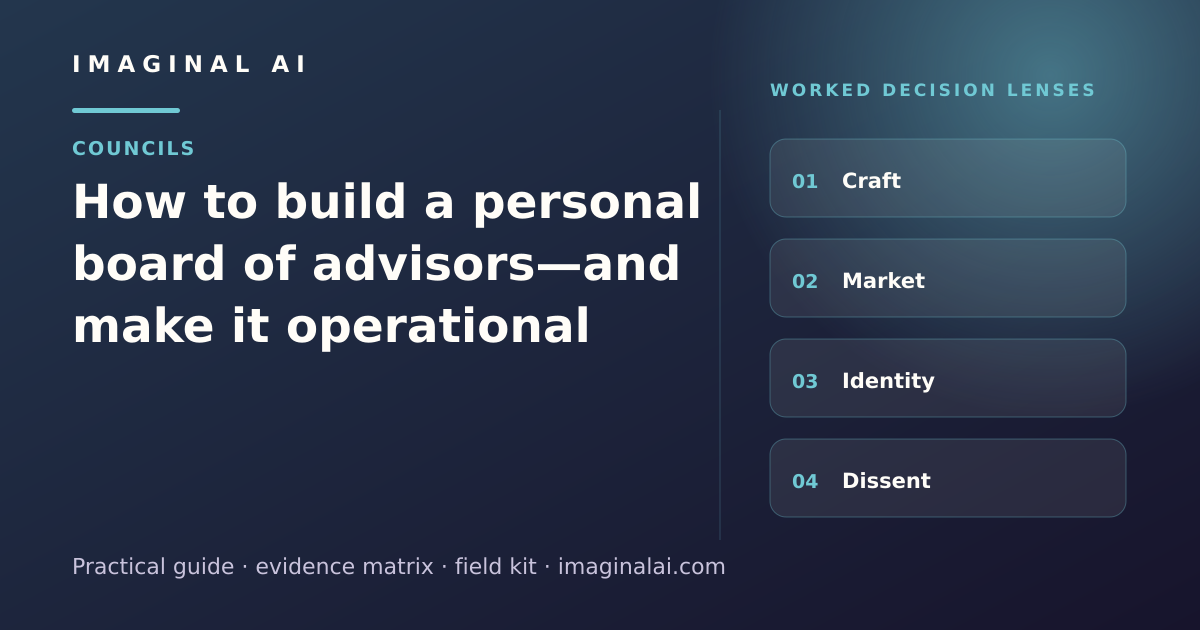
A personal board of advisors is a deliberately assembled group of perspectives that helps one person make, execute, and review important decisions. It can include human mentors, peers, qualified professionals, documented thinkers, and source-grounded AI mentors—but those members do not carry the same authority or responsibility.
The board becomes operational when it has a charter, seats, a meeting rhythm, and a decision record. Without those elements, it is usually a contact list or an imagined collection of admired people.
Begin with a charter
Write one paragraph explaining why the board exists. Name the decisions it may help with, the areas it must not handle without qualified expertise, the confidentiality rules, and the period for which the arrangement will run. A six-month charter tied to a defined transition is easier to maintain than a permanent aspiration to “have mentors.”
List the recurring decision types in your current season: choosing opportunities, negotiating, managing energy, leading a team, allocating capital, learning a field, or resolving value conflicts. The board should reflect the actual decisions on your calendar. A seat that never receives a meaningful question is decorative and should be removed.
Design a mixed board
Human mentors contribute relationship, lived experience, tacit knowledge, introductions, and personal challenge. Peers contribute immediacy and mutual accountability. Qualified professionals handle regulated or high-stakes domains. Historical and source-grounded AI mentors contribute repeatable access to documented lenses. Treating these as interchangeable creates false confidence.
A mixed board can work well when the handoffs are explicit. Use an AI council to prepare a decision brief and surface questions. Take the refined brief to a human mentor or professional. Record their advice in your own words and mark it as human input. Use the system later to compare the decision with the outcome, not to rewrite the human advisor into a synthetic persona.
Choose seats and people
Common seats include strategic direction, execution, relationships, domain expertise, ethics, and red-team review. Define the responsibility of each seat in one sentence and write two sample questions it should own. Then choose a person or mentor corpus that genuinely covers that responsibility. Avoid giving one admired advisor every seat.
Ask whether the board contains enough difference to challenge you. Similar careers, incentives, temperaments, and social positions can produce the same blind spots even when personalities differ. Add perspectives that question the problem definition, not only the proposed solution. Diversity is useful when it changes what evidence gets noticed and what trade-offs become speakable.
Create a workable cadence
Use a monthly or decision-triggered rhythm rather than manufacturing meetings. Before a session, circulate or write a one-page brief: decision, context, options, constraints, known evidence, assumptions, and deadline. Ask members independently where possible. Independent first responses reduce the tendency of early voices to organise the entire conversation.
End with a decision record. Capture what was decided, why, what evidence mattered, which uncertainty remains, who owns the next action, and when the result will be reviewed. For human advisors, send a concise follow-up and respect the time you requested. For AI seats, preserve citations and make the distinction between sourced claims and generated application visible.
Review the board itself
Every quarter, review both outcomes and composition. Which seat changed decisions? Which produced repeated but unused advice? Where did the board lack relevant evidence? Which human relationships need reciprocity rather than another request? The point is not to score people; it is to keep the system aligned with the decisions you actually face.
Retire seats when the mission changes. Add temporary experts for a specific transition. Keep a record of unresolved dissent so that a minority warning is not erased by a successful short-term result. A personal board earns its place when it improves decision quality and learning—not when it makes the owner feel surrounded by impressive names.
Worked example · Illustrative scenario
Portfolio lab: build a board around recurring career decisions
A senior operator is deciding whether to remain in a scaling company, join an early-stage venture, or begin an independent practice. She already has many helpful contacts, but most share the same industry and incentives.
| Lens | Question | Evidence to inspect | Effect on the decision |
|---|---|---|---|
| Craft | Who can judge the quality of the operator’s work? | Direct knowledge of the discipline, standards, strengths, and development gaps. | Ask this adviser to test the role’s actual work rather than its title or prestige. |
| Market | Who sees demand and career-option value clearly? | Hiring patterns, client budgets, sector movement, and comparable transitions. | Use this seat to challenge assumptions about opportunity and timing. |
| Identity | Who can separate aspiration from borrowed status? | Longitudinal knowledge of motives, energy, values, and repeated avoidance. | Give this person permission to question why an option feels important. |
| Dissent | Who is structurally free to oppose the preferred story? | Different incentives, lived experience, and no dependence on the chosen outcome. | Require a written strongest objection before commitment. |
The operator invites four people into explicit roles, defines a limited cadence, and keeps responsibility for the decision. AI mentors may prepare questions and preserve the record, but human advisers provide contextual judgment, relationships, and accountability the system cannot reproduce.
Every quarter, assess whether each seat changed a question, surfaced evidence, or improved follow-through. Retire honorary seats, close repeated perspective gaps, and reciprocate rather than treating the board as a one-way extraction mechanism.
Free practical field kit · No signup required
Personal board charter and seat map
Use this charter to turn an informal contact list into a respectful advisory system. It clarifies what you need, whom to ask, how little time is required, and how the board will remain useful.
- 01
Board charter
Name the twelve-month objective, decisions the board may help with, confidentiality boundary, and decisions you retain.
- 02
Capability gaps
List the perspectives, experience, networks, challenge, and emotional steadiness missing from your current circle.
- 03
Candidate map
For each seat, name possible advisers, existing relationship, conflicts, likely contribution, and a proportionate first ask.
- 04
Operating cadence
Set the preparation format, meeting or outreach frequency, time limit, update method, and way you will reciprocate.
- 05
Board review
Choose a date to assess attendance, candour, overlap, new gaps, and whether a seat should rotate or close.
Copy these prompts into your working document, or use your browser’s Print command to save this field kit as a PDF. The worksheet is available without an email gate.
Model a digital advisory board →FAQ
Frequently asked questions
Who should be on a personal board of advisors?
Choose people and tools for distinct recurring decision functions, mixing human mentors, peers, qualified professionals, and carefully bounded AI or source-based perspectives.
How often should a personal advisory board meet?
Use a cadence that matches real decisions—often monthly, quarterly, or when a defined decision threshold is reached.
Can AI mentors be part of a personal board?
Yes, as clearly labelled source-grounded tools. They should not be confused with human relationships or qualified professional advice.
Sources and method
Trace the guide
This guide was developed with AI-assisted research and editorial tooling, then checked against Imaginal AI’s registered source maps, internal-link graph, and content-quality tests. Read the editorial standards, AI-assistance disclosure, and correction policy.
- Benjamin Franklin, AutobiographyRegistered source edition relevant to self-examination and practical routines.
- Mary Parker Follett, The New StateRegistered source edition for participation, power, and integration.
- Build an Imaginal CouncilThe role-defined multi-mentor design method used to assign distinct responsibilities.