Council design
How to build an AI advisory council for a real mission
Design an Imaginal Council by defining the mission, assigning functional seats, preserving disagreement, and converting counsel into accountable action.
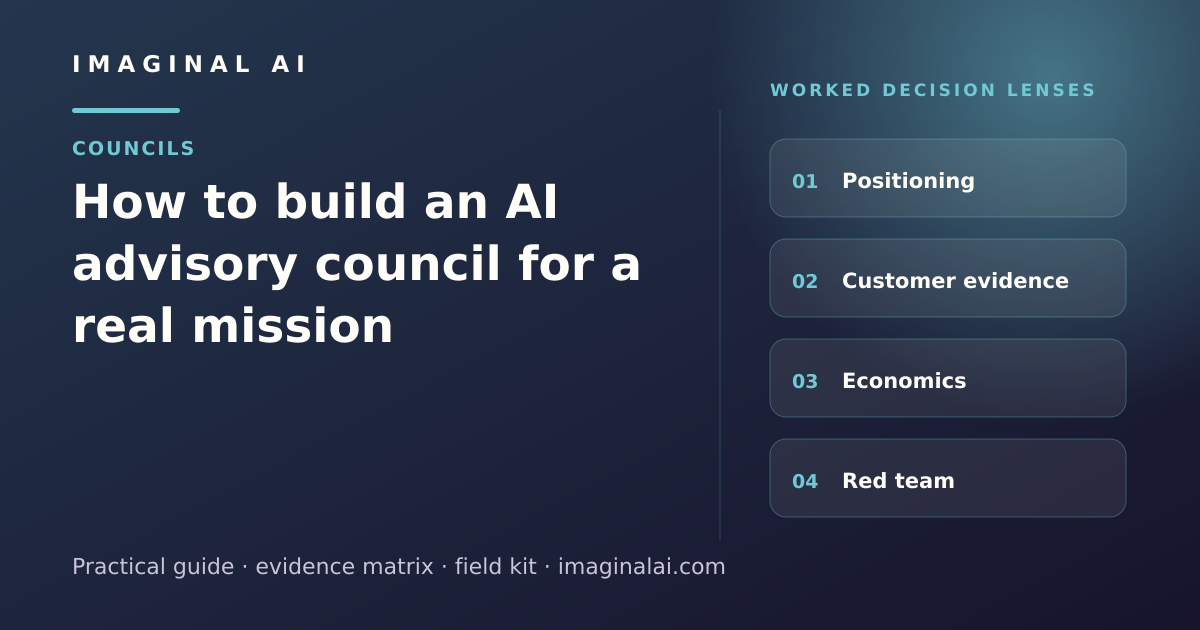
A council is useful when the problem contains several different jobs. Choosing a direction may require strategy, market judgment, organisational design, execution, persuasion, ethics, and resilience. One mentor can illuminate a part of that system; a well-built council makes the parts and their tensions visible.
The design mistake is to begin with admired names. Start with the mission, write the seats, and only then select mentors whose documented work can responsibly occupy those functions.
Write the mission before choosing the room
A useful mission brief states the desired change, current position, main obstacle, time horizon, constraints, previous attempts, and the decision that must be made now. “Help me grow my business” is too broad. “Choose a defendable entry segment for a six-month launch with two founders, limited capital, and no existing distribution” gives the council something it can examine.
Separate facts from assumptions in the brief. Facts are observations you can support; assumptions are beliefs that might be tested; constraints are limits you have chosen or cannot presently change. The distinction prevents the council from spending its energy solving an invented problem or treating a preference as an immutable law.
Define seats as functions
Write the roles without names first. A venture council might need positioning, customer evidence, economic logic, operating design, communication, and a red-team seat. A leadership council might need authority, integration, conflict, incentives, ethics, and self-command. The seat description should state the question that function owns and the kind of evidence it should challenge.
Then map mentors to seats. Sun Tzu may serve positioning and information; Adam Smith may examine exchange and incentives; Mary Parker Follett may challenge command-and-control assumptions; Frederick Winslow Taylor may interrogate process; William James may inspect habit and attention. The point is not to make these figures agree. It is to give each corpus a precise job.
Control size and redundancy
Four to six seats are usually enough for an active mission. A larger room increases the cost of reading, comparison, and synthesis. Add a seat only when it covers a distinct decision function or missing risk. Two mentors who use different language to deliver the same advice create the appearance of diversity without changing the decision.
Run a redundancy check by asking what evidence would cause each seat to object. If several seats would raise the same objection for the same reason, combine or replace them. Also run a silence check: which stakeholder, constraint, moral concern, or implementation reality has no advocate in the room? That missing voice is often more important than another celebrated thinker.
Preserve disagreement before synthesis
Ask each mentor independently from its own corpus before the Meta-Advisor summarises the room. Show the retrieved citations and let the user inspect how each answer framed the problem. Early synthesis can erase the exact differences a council was created to reveal. A good session records agreements, disagreements, assumptions under dispute, and the evidence each position would need.
The user remains the decision owner. The synthesis should not choose by vote or average. It should present the trade-off, identify reversible and irreversible elements, and propose a test where uncertainty can be reduced. When values conflict rather than facts, the system should say so explicitly instead of treating the disagreement as a search problem.
Turn the session into a learning loop
End with one decision, a dated commitment, an owner, a success signal, and a review date. If the decision is not ready, define the evidence-gathering action that will make it ready. Assign a mentor to follow up based on the function involved: the strategy seat may check the assumption, while the execution seat may check whether the experiment actually ran.
At review, compare expectation with result. Preserve what changed in the mission brief, which mentor’s warning proved useful, where the sources were insufficient, and what the next council composition requires. A council that only produces eloquent conversation becomes entertainment. A council that records decisions and outcomes becomes an accumulating decision system.
Worked example · Illustrative scenario
Worked example: choose a defensible launch segment
A two-founder B2B software company has six months of runway, no repeatable distribution, and three plausible customer segments. The immediate decision is which one segment should receive the next six weeks of interviews and product adaptation.
| Lens | Question | Evidence to inspect | Effect on the decision |
|---|---|---|---|
| Positioning | Where can the company create a defendable contrast? | Urgency, incumbent alternatives, buyer language, switching friction, and competitor attention. | Eliminate the broad segment where the product has no credible wedge. |
| Customer evidence | Which pain is observed rather than inferred? | Interview behaviour, current workarounds, budget ownership, failed attempts, and purchase triggers. | Rank the segment with repeated costly behaviour above the one with enthusiastic compliments. |
| Economics | Can this segment support the acquisition and service model? | Reachable account count, expected contract value, sales effort, onboarding cost, and retention mechanism. | Reject a segment whose apparent demand cannot cover a founder-led sales motion. |
| Red team | What would make the preferred segment a false positive? | Selection bias, regulatory dependency, integration burden, incumbent response, and six-week failure signals. | Convert the leading recommendation into a bounded test with an explicit stop condition. |
The council does not vote on a market. It produces a six-week commitment: interview a defined buyer population, test one switching proposition, measure evidence of budgeted urgency, and stop if fewer than a pre-agreed number enter a serious buying process.
At week six, compare the original assumptions with observed behaviour. Preserve which seat’s objection changed the test, which evidence remained missing, and whether the next council needs a different function rather than another admired name.
Free practical field kit · No signup required
AI advisory council design canvas
Complete this canvas around one real decision. It prevents the council from becoming a decorative list of admired names and gives every seat a distinct responsibility, evidence need, and challenge.
- 01
Mission and decision
State the objective, current situation, decision deadline, constraints, and what must be different after the session.
- 02
Seat functions
Name four to six missing capabilities or failure modes, then assign one distinct responsibility to each seat.
- 03
Independent question
Write the shared question every seat receives before members can see or react to one another’s answers.
- 04
Disagreement ledger
Record the conflicting assumptions, evidence, values, and risks without forcing an early consensus.
- 05
Commitment and review
Choose the action, owner, due date, success signal, and condition that will reopen the decision.
Copy these prompts into your working document, or use your browser’s Print command to save this field kit as a PDF. The worksheet is available without an email gate.
Build this council →FAQ
Frequently asked questions
How many AI mentors should be in a council?
Use the smallest set that covers distinct decision functions. Four to six active seats is a practical starting range for most missions.
Should all council mentors agree?
No. Productive disagreement exposes assumptions and trade-offs. The system should preserve independent answers before synthesis.
How do I choose mentors for a business mission?
Define the functions first—such as positioning, customer evidence, economics, operations, communication, and red-team review—then choose source-grounded mentors for those seats.
Sources and method
Trace the guide
This guide was developed with AI-assisted research and editorial tooling, then checked against Imaginal AI’s registered source maps, internal-link graph, and content-quality tests. Read the editorial standards, AI-assistance disclosure, and correction policy.
- Sun Tzu, The Book of WarRegistered strategy source edition used in the source preflight.
- Mary Parker Follett, The New StateA registered organisational source edition on participation, coordination, power, and integration.
- Adam Smith, The Wealth of NationsRegistered source for exchange, incentives, and economic structure.