Council quality
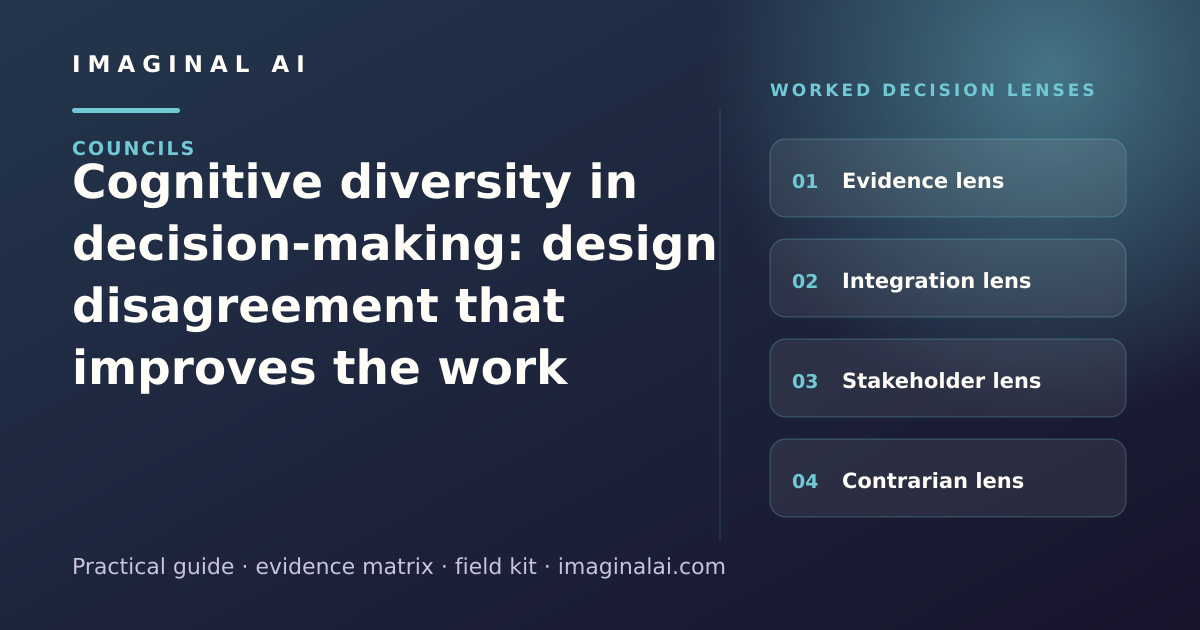
Cognitive diversity in decision-making: design disagreement that improves the work
Build useful cognitive diversity by separating roles, sources, assumptions, and incentives—then preserve independent views before synthesis.
Cognitive diversity is not a count of personalities or a promise that disagreement automatically improves decisions. It is a property of the decision process: different participants notice different evidence, use different causal models, challenge different assumptions, and represent different consequences.
A multi-mentor council can make those differences visible, but only if roles and source boundaries are designed deliberately. Several personas generated by the same general context can produce stylistic variety while sharing the same blind spots.
Define the diversity the decision needs
Begin with the object of disagreement. A market-entry decision might need different views of customer value, competitive response, unit economics, operating capacity, organisational power, and ethical impact. Those are distinct mechanisms. Selecting seats by broad category alone—“a business person, a philosopher, and a psychologist”—does not guarantee that the decisive assumptions will be challenged.
Write an adversarial question for each seat. What would make the customer not care? How could a competitor neutralise the advantage? Which incentive produces an unintended behaviour? Where does authority conflict with responsibility? Who bears a cost absent from the model? These questions define cognitive work rather than decorative representation.
Separate sources and roles
A source-grounded council should retrieve each mentor independently. The system must not blend documents into one context and then label portions with different names. Separate corpora preserve traceability and make it possible to discover that one source genuinely has little to say on the question.
Role separation matters too. The same mentor might plausibly serve more than one function, but assigning one clear seat in a given mission reduces ambiguity. If every mentor is asked for “general advice,” their answers tend to converge around generic competence. A defined role gives the disagreement a productive object.
Protect independent first judgments
Early answers shape later ones. In a human meeting, status and confidence can organise the room. In an AI workflow, a synthesis shown too early can become the frame that every follow-up inherits. Collect first responses separately, with the same decision brief and explicit seat question, before showing a combined view.
Independence is not absolute: council seats still share the user’s brief and may rely on the same model provider. Be honest about that technical dependence. The aim is to reduce avoidable convergence by separating source evidence, prompts, and first-pass reasoning—not to claim that software outputs are statistically independent experts.
Classify disagreement
When answers conflict, label the source. Evidence disagreement concerns what is true now. Model disagreement concerns how causes interact. Forecast disagreement concerns what may happen. Objective disagreement concerns what should be optimised. Risk disagreement concerns acceptable downside. Value disagreement concerns limits that should not be traded away.
Each class requires a different response. Gather data for an evidence dispute. Run a reversible test for a model dispute. Clarify ownership for an objective conflict. Seek governance or professional advice for a legal, safety, or ethical limit. Calling every conflict “different perspectives” avoids the work of resolution.
Prevent performative dissent
A red-team seat can become theatre if it must object to everything. Require objections to name the threatened objective, causal mechanism, evidence, and trigger that would make the warning relevant. Likewise, require the leading option to state what result would change its mind. Both sides should be exposed to falsification.
Do not reward volume or novelty alone. A familiar operational constraint may matter more than an ingenious hypothetical. Score the contribution by whether it changes the brief, test, option, threshold, or decision. Dissent that changes nothing may still be recorded, but it should not be mistaken for decision value.
Learn which diversity was useful
At review, ask which seat noticed evidence others missed and which disagreement predicted a real implementation issue. Also ask where the council was collectively silent. The answer can change future templates: perhaps the mission needed a stakeholder seat, a technical operator, or a professional review rather than another historical lens.
Do not use outcome alone to dismiss dissent. A risk may have been real even if it did not materialise in one trial. Review the quality of the mechanism and evidence, then update its probability or trigger. The goal is an adaptive council whose composition improves with the mission.
Worked example · Illustrative scenario
Composition lab: diversify mechanisms, not decorative labels
A leadership team is evaluating an acquisition. The room includes people from several functions, yet all were promoted through the same operating culture and quickly converge on the chief executive’s framing.
| Lens | Question | Evidence to inspect | Effect on the decision |
|---|---|---|---|
| Evidence lens | Who tests whether the demand thesis is observable? | Customer retention, win-loss evidence, cohort quality, and alternative explanations. | Collect an independent evidence assessment before group discussion. |
| Integration lens | Who examines the operating mechanism after close? | Systems, talent dependencies, decision rights, process mismatch, and transition capacity. | Price integration difficulty into the option rather than treating it as execution detail. |
| Stakeholder lens | Who represents people carrying hidden costs? | Employees, customers, partners, regulators, and communities affected by the transition. | Surface distributional effects and duties before approval. |
| Contrarian lens | Who can construct a viable no-deal strategy? | Alternative uses of capital, internal capability, partnership routes, and timing. | Prevent the acquisition from being compared only with inactivity. |
The team assigns independent written briefs before the meeting and delays synthesis until each mechanism has been stated. Diversity is measured by changed assumptions and evidence, not the number of biographies represented around the table.
After the decision, record which lens introduced unique information and whether authority pressure altered stated confidence. Change the process if dissent appears only after the decision owner has left the room.
Free practical field kit · No signup required
Cognitive-diversity seat planner
Use this planner to design useful difference around a specific decision. It focuses on methods, information, incentives, and failure modes rather than assuming that a varied list of names will automatically improve judgment.
- 01
Decision demands
Name the strategic, operational, human, economic, ethical, and technical questions the decision must answer.
- 02
Distinct lenses
Assign seats by method or evidence base and state what each can see that the others are likely to miss.
- 03
Independent first pass
Define how each seat records its view, confidence, missing evidence, and leading objection before group discussion.
- 04
Disagreement classes
Sort conflicts into facts, assumptions, causal models, values, time horizons, risk appetite, or incentives.
- 05
Learning review
After the outcome, record which difference changed the decision usefully and which diversity was redundant or performative.
Copy these prompts into your working document, or use your browser’s Print command to save this field kit as a PDF. The worksheet is available without an email gate.
Design a diverse council →FAQ
Frequently asked questions
What is cognitive diversity?
In a decision process, it means participants use meaningfully different evidence, causal models, assumptions, objectives, or risk frames.
Does disagreement always improve decisions?
No. Disagreement helps when it is relevant, evidence-aware, and connected to a change in the brief, test, threshold, option, or decision.
How can an AI council preserve diverse perspectives?
Use separate source corpora, explicit seat roles, independent first responses, and synthesis that labels the cause of disagreement.
Sources and method
Trace the guide
This guide was developed with AI-assisted research and editorial tooling, then checked against Imaginal AI’s registered source maps, internal-link graph, and content-quality tests. Read the editorial standards, AI-assistance disclosure, and correction policy.
- John Stuart Mill, On LibertyRegistered source edition relevant to dissent and individuality.
- Mary Parker Follett, The New StateRegistered source edition relevant to participation, integration, and collective process.
- Francis Bacon, Novum OrganumRegistered source edition for inquiry and sources of error as a council lens.