Adversarial review
How to run a red-team council and pre-mortem without creating theatre
Use a structured red-team and pre-mortem process to identify failure mechanisms, assign evidence, set triggers, and strengthen a real decision.
A red team is not a licence to be negative, and a pre-mortem is not a competition to invent the most dramatic catastrophe. Both are useful when they identify plausible failure mechanisms early enough to change a decision, test, threshold, or contingency.
The session needs a clear target, independent preparation, evidence standards, and an owner for every accepted risk. Otherwise, challenge becomes performance and the main plan remains untouched.
Choose the target and rules
Write the plan in operational terms: objective, mechanism, actors, resources, sequence, assumptions, and success signal. State which parts are fixed and which can change. The red team’s job is to test the plan as written, not to replace the mission with its own preferences.
Set behavioural rules. Critique claims and mechanisms, not people. Distinguish evidence from scenario. Declare conflicts or incentives. Time-box the session and give the decision owner a right of response after independent challenges are visible. For high-stakes domains, include qualified professionals rather than treating an AI exercise as assurance.
Run the pre-mortem independently
Ask participants to imagine that the plan has failed by a defined date and write the most plausible reasons before discussion. Require each reason to identify the causal chain: what happened first, why the organisation did not notice, and how the effect reached the objective. This produces more usable material than a list of abstract risks.
Cluster reasons by mechanism—customer indifference, competitive response, operating failure, incentive conflict, governance, trust, technical dependency, or external constraint. Preserve unusual but plausible chains without allowing low-evidence spectacle to dominate. The decision owner should not defend the plan during collection.
Assign red-team seats
Different seats can attack different layers. A strategy seat examines information and counteraction. An economics seat tests incentives and exchange. An operations seat follows the process to its bottleneck. An organisational seat examines power, ownership, and conflict. A stakeholder seat identifies costs or exclusions absent from the internal model.
Source-grounded mentors can contribute documented lenses, but the role remains explicit and bounded. They do not know the company’s facts unless those facts appear in the brief. Ask each seat what evidence it needs and where its corpus is insufficient. A limitation notice is more valuable than a confident objection built on invented context.
Rank by exposure and detectability
For each failure mechanism, estimate consequence, likelihood range, speed, detectability, and reversibility. Avoid false precision. A risk with moderate consequence but poor detectability may deserve earlier instrumentation than a severe risk that would be obvious and reversible. Identify correlated risks that can fail together.
Then mark which assumption the risk attacks and whether present evidence already bears on it. Some objections disappear when the brief is corrected. Others reveal that the leading option rests on a belief no one has tested. Those are candidates for an experiment, contingency, or a different strategic option.
Convert challenge into decision changes
Every accepted material risk should produce one of five outputs: new evidence to gather, a plan modification, a contingency, a monitored trigger, or an explicit acceptance of downside. Assign an owner and date. If the red team changes none of these, ask whether the session was merely ritual or whether the plan was already robust.
Do not attempt to mitigate every imaginable risk. Protection has cost and can destroy the opportunity. The decision owner should state which risks are accepted, why the expected mission value justifies them, and which limits remain non-negotiable. This is accountable judgment, not elimination of uncertainty.
Review the red team after the outcome
At the after-action review, compare actual problems with the pre-mortem. Which mechanisms appeared? Which warnings were dismissed? Which accepted risks stayed dormant? Which unexpected issue had no seat? Avoid declaring the exercise successful merely because one prediction was right; examine whether the warning changed action in a useful way.
Update future council templates and triggers. A recurring operating failure may justify a permanent execution seat. Repeated speculative objections may need tighter evidence rules. Red-teaming matures when the organisation learns how it tends to miss, overstate, and respond to risk.
Worked example · Illustrative scenario
Pre-mortem lab: stress-test a launch plan before commitment hardens
A team plans to launch a regulated workflow product in twelve weeks. The schedule assumes a partner integration, a short customer security review, and immediate adoption by frontline staff who were not involved in product selection.
| Lens | Question | Evidence to inspect | Effect on the decision |
|---|---|---|---|
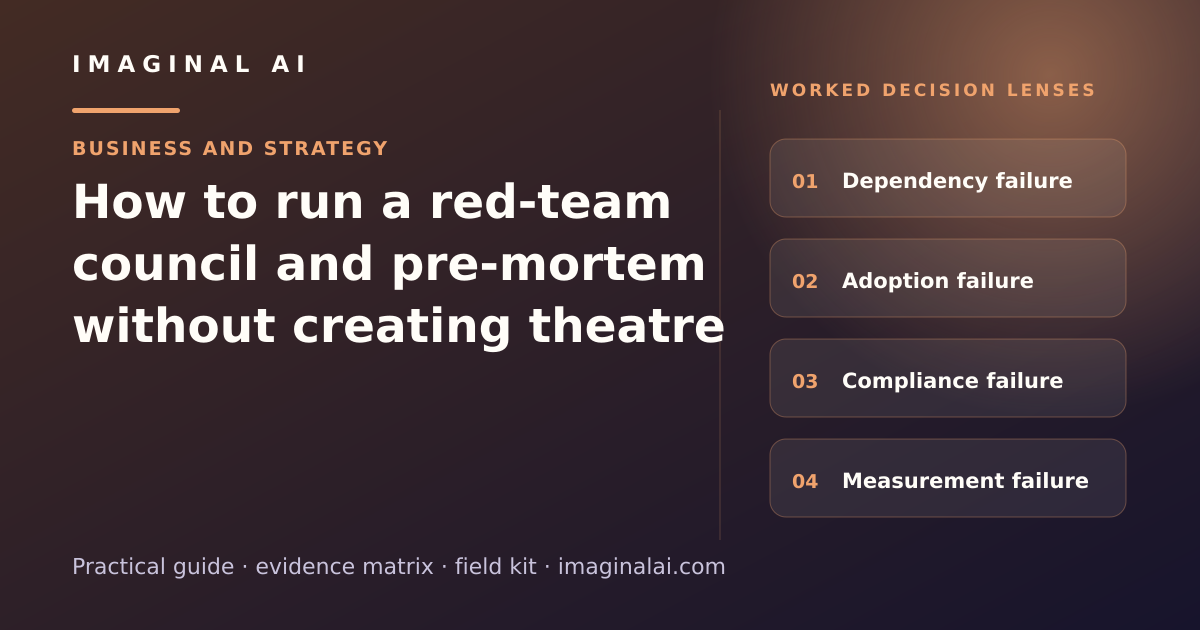
| Dependency failure | Which external event can break the sequence? | Partner API readiness, contract timing, review queues, ownership, and fallback capability. | Create a dated fallback path rather than recording dependency risk abstractly. |
| Adoption failure | Why might intended users resist or bypass the product? | Workflow burden, incentives, training, local workarounds, and manager behaviour. | Add observed workflow trials before declaring launch readiness. |
| Compliance failure | Which claim or data flow could halt deployment? | Data inventory, jurisdiction, retention, access, model behaviour, and approval evidence. | Escalate unresolved regulated questions to accountable specialists. |
| Measurement failure | How could launch metrics hide a weak outcome? | Provisioned versus active use, compelled activity, cohort mix, time window, and downstream value. | Predefine adoption and value signals that cannot be satisfied by account creation alone. |
The launch remains scheduled only if each critical failure mechanism has an owner, observable trigger, and response. The red team is not asked to produce more anxiety; it is asked to change the plan where a plausible failure lacks a control.
After launch, compare actual issues with the pre-mortem. Reward useful warnings, examine surprises, and remove ritual questions that never alter action. A red team earns trust by improving plans, not by predicting doom without responsibility.
Free practical field kit · No signup required
Red-team and pre-mortem worksheet
Run this worksheet independently before the challenge session. It converts imagined failure into causal mechanisms, evidence, mitigations, ownership, and triggers instead of rewarding dramatic but unusable objections.
- 01
Target plan
State the objective, mechanism, sequence, assumptions, fixed constraints, flexible elements, success signal, and decision owner.
- 02
Failure chain
Assume failure by a named date and describe what happened first, why it was missed, and how it reached the objective.
- 03
Exposure
Estimate consequence, likelihood range, speed, detectability, reversibility, correlation, and the assumption each risk attacks.
- 04
Decision response
Choose evidence gathering, plan change, contingency, monitored trigger, specialist escalation, or explicit risk acceptance.
- 05
Outcome review
Compare the pre-mortem with actual problems and record which warnings changed action, were noise, or revealed a missing seat.
Copy these prompts into your working document, or use your browser’s Print command to save this field kit as a PDF. The worksheet is available without an email gate.
Run a red-team council →FAQ
Frequently asked questions
What is the difference between a red team and a pre-mortem?
A pre-mortem imagines a future failure and works backward to plausible causes. A red team more broadly challenges the plan, assumptions, evidence, and responses.
Who should lead a red-team session?
Use a facilitator who can protect independent challenge and keep critique focused on mechanisms. The decision owner should listen before responding.
How do you stop red-teaming from becoming negativity?
Require each objection to name a mechanism, evidence need, consequence, and actionable output such as a test, change, contingency, trigger, or accepted risk.
Sources and method
Trace the guide
This guide was developed with AI-assisted research and editorial tooling, then checked against Imaginal AI’s registered source maps, internal-link graph, and content-quality tests. Read the editorial standards, AI-assistance disclosure, and correction policy.
- Sun Tzu, The Book of WarRegistered source edition for information, position, and adversarial response.
- Niccolò Machiavelli, The PrinceRegistered source edition for power, timing, and political consequences.
- Carl von Clausewitz, On WarRegistered source edition for friction, uncertainty, and conflict as a bounded strategic lens.