Founder strategy
How founders can use an AI advisory board without outsourcing judgment
A founder-focused guide to using multiple AI mentors for positioning, economics, operations, organisational design, red-teaming, and review.
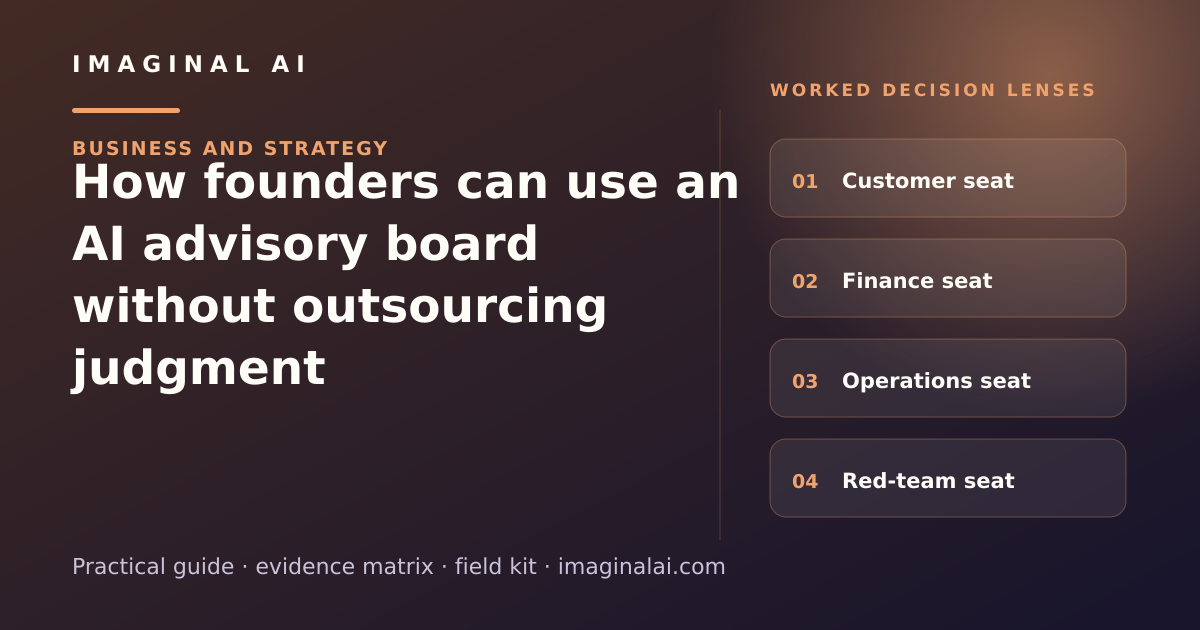
Founders rarely lack advice. They lack a reliable way to frame the current decision, separate evidence from confidence, compare incompatible recommendations, and preserve what happened after a choice. An AI advisory board is useful when it improves that system—not when it produces more opinions.
The board should be built around venture functions and queried from isolated source perspectives. The founder remains accountable for evidence, professional review, stakeholder impact, and the final decision.
Use venture functions as seats
A useful founder council might include customer evidence, positioning, economic model, operating system, organisational design, communication, and adversarial review. Early-stage companies do not need every seat active at once. Select the functions implicated by the decision. Pricing, hiring, market entry, and co-founder conflict each demand a different room.
Documented thinkers can occupy those roles without becoming universal business gurus. Adam Smith may challenge the exchange and incentive model; Sun Tzu may examine information and position; Mary Parker Follett may inspect power and integration; Frederick Winslow Taylor may expose process ambiguity; Thorstein Veblen may question status-driven demand. The seat limits the claim.
Build a founder decision brief
State the decision in a form that can be made by a date. Include present evidence, customer behaviour, cash or time constraints, strategic options, assumptions, irreversible consequences, and what has already been tried. Remove promotional language. If the brief sounds like a pitch deck, it is probably hiding the uncertainty the council needs to examine.
Add a disconfirming-evidence field: what observation would make the leading option less attractive? Add a stakeholder field: who bears the cost if the decision is wrong? Add a non-delegable field: which part requires the founders’ values or a qualified professional rather than mentor synthesis? These prompts make the brief more useful before any answer is generated.
Ask for tests, not predictions
Questions such as “Will this startup succeed?” invite theatre. Ask instead which assumption carries the most downside, what evidence is missing, how a competitor might respond, which segment has the clearest urgent problem, or what can be learned within two weeks. The output should narrow uncertainty or clarify a trade-off, not create borrowed certainty.
Require each seat to propose an observable test and identify what result would change its recommendation. A positioning seat might propose a message test; an economics seat might specify a contribution-margin threshold; an organisational seat might identify an ownership conflict. The Meta-Advisor can then combine tests into a sequence based on cost, reversibility, and information value.
Handle disagreement like a board, not a poll
Do not count recommendations. Ask why the seats differ. One may optimise survival, another speed, another organisational health, and another long-term position. Those objectives cannot be averaged without making a hidden value choice. Record the objective and risk model behind each recommendation, then let the founders decide which trade-off governs.
Preserve minority warnings in the decision record. If the company chooses speed despite an operations objection, write the condition that will trigger re-evaluation. The warning then becomes a monitored assumption rather than a defeated opinion. This is one place where persistent software can improve on a lively meeting whose dissent disappears by Monday.
Connect advice to the operating week
A council session should produce an owner, next action, deadline, success signal, and review. Integrations can time-block a customer interview, create a task, or push the decision record to a workspace, but the user must confirm external writes. The product should never create commitments or communicate with stakeholders invisibly.
At review, compare predicted learning with actual learning. Was the test run? Did the result answer the question? Which assumption moved? What new constraint emerged? Update the mission brief and council seats. This turns the advisory board into a founder learning system rather than an answer generator that restarts from zero each session.
Worked example · Illustrative scenario
Founder lab: pressure-test a pricing change without outsourcing judgment
A founder wants to replace a low monthly subscription with a higher annual contract. The change could improve cash flow but may slow adoption, alter the buyer, and conceal product-retention problems behind longer commitments.
| Lens | Question | Evidence to inspect | Effect on the decision |
|---|---|---|---|
| Customer seat | What new burden does annual commitment create? | Buyer authority, procurement steps, perceived risk, onboarding time, and proof requirements. | Define which segment can credibly make the larger commitment. |
| Finance seat | Which economic mechanism should materially improve? | Cash timing, discount, churn visibility, collection risk, service cost, and runway. | Model the change without assuming annual contracts fix weak retention. |
| Operations seat | Can delivery operations support the larger promise? | Implementation capacity, support load, renewal ownership, and exception handling. | Limit the pilot to a cohort the team can onboard properly. |
| Red-team seat | How could the test falsely appear successful? | Founder-selected accounts, heavy discounting, delayed cancellations, and weak comparison periods. | Pre-register success and failure signals before offers are made. |
The founder chooses a controlled cohort test rather than an immediate company-wide change. The record names the expected economic mechanism, accounts eligible for the offer, minimum adoption and activation signals, and a date for comparing retained behaviour.
The founder—not the board—signs the decision. At review, separate sales execution, customer fit, product value, and pricing design so a disappointing result is not converted into a vague instruction to “try harder.”
Free practical field kit · No signup required
Founder advisory-board decision brief
Prepare this brief before asking an AI council or human advisory board for input. It gives every seat the same operating facts and forces counsel to produce tests rather than unsupported predictions.
- 01
Venture decision
State the choice, stage, runway, decision owner, deadline, and the customer or company outcome at stake.
- 02
Functional seats
Assign distinct ownership for market, economics, product, operations, people, power, ethics, or another relevant lens.
- 03
Evidence packet
List customer evidence, unit economics, delivery constraints, competitor signals, assumptions, and material unknowns.
- 04
Tests and triggers
For every major recommendation, define the cheapest useful test and the threshold that changes the plan.
- 05
Operating-week link
Translate the decision into one owner, dated action, metric, check-in, and board question for the next review.
Copy these prompts into your working document, or use your browser’s Print command to save this field kit as a PDF. The worksheet is available without an email gate.
Assemble a founder council →FAQ
Frequently asked questions
What should an AI founder advisory board include?
Start with the functions implicated by the decision: customer evidence, positioning, economics, operations, organisational design, communication, and red-team review.
Can an AI advisory board make business decisions for me?
No. It can structure evidence, surface assumptions, compare source-grounded lenses, and track reviews, but founders remain responsible for the decision.
Which founder questions should go to a professional?
Legal, tax, accounting, employment, safety, investment, and other regulated or high-stakes matters require appropriately qualified human advice.
Sources and method
Trace the guide
This guide was developed with AI-assisted research and editorial tooling, then checked against Imaginal AI’s registered source maps, internal-link graph, and content-quality tests. Read the editorial standards, AI-assistance disclosure, and correction policy.
- Adam Smith, The Wealth of NationsRegistered source edition for exchange and economic organisation.
- Frederick Winslow Taylor, Principles of Scientific ManagementRegistered source edition for process and operating analysis.
- Thorstein Veblen, The Theory of the Leisure ClassRegistered source edition for status, consumption, and institutional critique.