Leadership council
How to build a leadership advisory council with distinct roles
Create a leadership advisory council that separates strategy, operations, people, power, ethics, and dissent before turning counsel into accountable action.
A leadership advisory council is a repeatable set of perspectives assembled around the decisions a leader actually faces. It is not a collection of admired personalities. Each seat has a defined responsibility, evidence boundary, and question that prevents a material part of the situation from being ignored.
The council can include human advisors, source-grounded AI mentors, or both. The design principles are the same: choose by function, preserve disagreement, disclose limits, and keep the decision with the accountable leader. The room should change as the mission and evidence change.
Diagnose the leadership work
List the decisions and recurring tensions that define the present role: direction, capital allocation, operating reliability, talent, conflict, stakeholder legitimacy, communication, or personal conduct. Rank where the leader lacks evidence, perspective, experience, or permission to be challenged. The council should fill those gaps rather than mirror existing strengths.
Define the mission and horizon. A crisis council, growth council, succession council, and ethics review may need different seats. Avoid creating a permanent pantheon whose presence no longer relates to the work. Stable relationships are valuable, but role fit should be reviewed as the objective changes.
Assign distinct seats
Write one sentence for each responsibility. A strategy seat examines position, alternatives, and external response. An operations seat tests capacity, sequence, and ownership. A people seat examines motivation, capability, conflict, and consequences for the team. A power seat maps authority and stakeholder reaction. An ethics seat identifies duties, rights, distribution, and legitimacy.
Add a dissent or red-team seat when the cost of conformity is high. Avoid assigning two seats the same broad instruction to “give leadership advice.” Overlap wastes time and makes synthesis vague. Where one advisor covers several functions, ask them to answer each role separately so trade-offs remain visible.
Choose sources and participation
For a human advisor, establish relevant experience, conflicts, confidentiality, availability, and the limits of the relationship. For an AI mentor, inspect the corpus, retrieval boundary, citations, privacy, and insufficiency behaviour. A historical source can contribute a lens without possessing modern facts or authority.
Include people close enough to see operations and independent enough to challenge the leader. Consider who is affected but absent. Some sessions need a specialist—legal, financial, medical, safeguarding, or technical—whose qualified judgment cannot be replaced by a general council. Name when escalation is mandatory.
Run the council as a decision process
Distribute a concise brief with objective, context, options, evidence, assumptions, constraints, and decision date. Collect independent views before open discussion. Let the accountable leader speak later where their preference could anchor the room. Ask each seat to state its recommendation, evidence, uncertainty, and strongest objection to its own view.
Synthesis should preserve disagreement. Identify points of agreement, contested assumptions, value conflicts, missing evidence, and trigger conditions. The Meta-Advisor or chair may organise the record but should not manufacture consensus. The leader makes the choice and states the trade-off accepted.
Convert counsel into development
End with an owner, dated action, success signal, and follow-up. At review, compare the original counsel and predictions with events. Ask which seat improved the decision, which warning lacked evidence, and which perspective was missing. Do not rate an advisor solely by whether a forecast happened; examine framing, preparation, and learning.
Review the council itself. Retire redundant seats, change instructions, add expertise, and reduce dependence on any one voice. A leadership council should strengthen the leader’s capacity to judge and build an organisation that can surface truth. It should not become a substitute identity or a permanent approval ritual.
Track development separately from agreement. A useful seat may repeatedly challenge the leader without having its recommendation adopted. Record whether the leader framed the issue more precisely, sought stronger evidence, noticed a stakeholder, delegated more clearly, or changed a recurring behaviour. Where no capability is improving, change the question, cadence, or seat. The council earns its place by improving judgment between meetings as well as the decision in the room.
Worked example · Illustrative scenario
Leadership lab: design a council for a first executive role
A newly appointed executive must lead former peers, set strategy, manage a board relationship, and change an underperforming operating system. Existing advisers are supportive but mostly share the executive’s functional background.
| Lens | Question | Evidence to inspect | Effect on the decision |
|---|---|---|---|
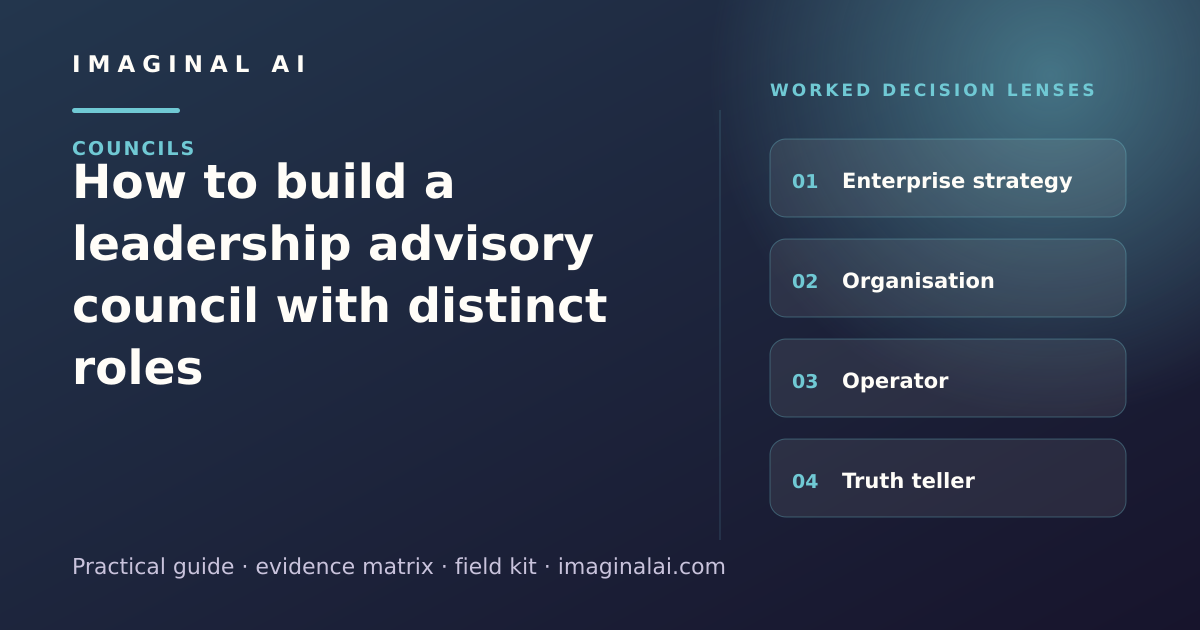
| Enterprise strategy | Who tests choices beyond the executive’s former function? | Business model, capital allocation, external environment, portfolio trade-offs, and board expectations. | Keep functional expertise from becoming the default enterprise frame. |
| Organisation | Who examines authority, structure, conflict, and integration? | Decision rights, interfaces, incentives, talent, informal power, and change capacity. | Diagnose system design before attributing every gap to individuals. |
| Operator | Who converts intent into cadence and evidence? | Priorities, owners, measures, meetings, escalation, resource load, and review. | Prevent strategic language from outrunning operational capacity. |
| Truth teller | Who can challenge identity and status pressure? | Independent relationship, longitudinal context, ethical boundary, and freedom from the executive’s favour. | Create a protected route for uncomfortable feedback the organisation may filter out. |
The executive forms a small role-defined council, sets confidentiality and cadence, and remains accountable to the company’s real governance. AI mentors support preparation and reflection; they do not become shadow directors or substitutes for the board.
Every quarter, audit which seat changed an actual decision and where perspective remained missing. Add or remove roles as the mission changes instead of preserving a ceremonial list for status.
Free practical field kit · No signup required
Leadership advisory council charter
Use this charter to build a council around the actual leadership work: judgment, people, communication, operations, ethics, and personal development. Each seat should own a different recurring question.
- 01
Leadership work
Name the mission, authority, stakeholders, current challenge, recurring decisions, capability gaps, and behaviours under review.
- 02
Seat responsibilities
Assign distinct roles such as strategy, truth-telling, people systems, communication, execution, ethics, or resilience.
- 03
Evidence and boundaries
Specify what each seat may know, which sources or experience it uses, conflicts, confidentiality, and professional limits.
- 04
Cadence and agenda
Set preparation, independent input, disagreement review, synthesis, commitment, follow-up, and rotation timing.
- 05
Development outcome
Choose one leadership behaviour, operating result, evidence signal, practice, owner, and review date for the cycle.
Copy these prompts into your working document, or use your browser’s Print command to save this field kit as a PDF. The worksheet is available without an email gate.
Assemble a leadership council →FAQ
Frequently asked questions
Who should be on a leadership advisory council?
Choose people or grounded mentor lenses for the actual work: strategy, operations, people, power, ethics, dissent, and specialist expertise where required.
How large should a leadership council be?
Use the smallest set that covers materially different mechanisms. Four to six seats is often workable; larger groups require stronger facilitation and may dilute accountability.
Can AI mentors be part of a leadership council?
Yes, as bounded source-grounded lenses with citations and clear limits. They do not replace accountable human judgment, current facts, or qualified professional advice.
Sources and method
Trace the guide
This guide was developed with AI-assisted research and editorial tooling, then checked against primary or authoritative sources, Imaginal AI’s registered source maps, the internal-link graph, and automated content-quality tests. Read the editorial standards, AI-assistance disclosure, and correction policy.
- Mary Parker Follett, Creative ExperienceA primary management source on participation, integration, conflict, and shared power.
- Plutarch, LivesA primary biographical source for comparative examination of leadership character and consequence.
- Imaginal AI council design guideThe role-defined multi-mentor method adapted here for leadership.