Execution system
From advice to action: turn counsel into commitments and learning
Convert mentor conversations into a decision, owner, dated commitment, success signal, follow-up, block diagnosis, and evidence-based review.
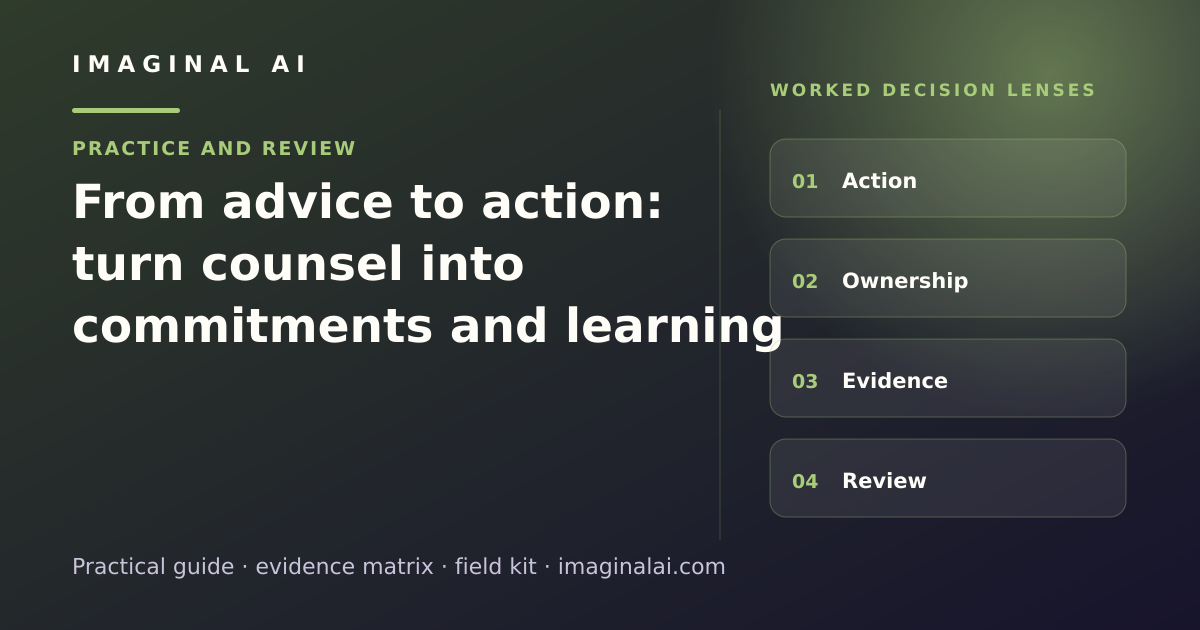
Advice creates value only when it changes attention, choice, action, or learning. The transition from counsel to commitment is where many advisory products stop: the conversation ends with a polished summary and the user returns to an unchanged calendar.
A commitment system should be small enough to use, specific enough to review, and humane enough to diagnose a miss rather than repeat the same reminder.
Name the decision before the task
A task without a decision can become motion that preserves ambiguity. Write what was chosen and which trade-off was accepted. If the council concluded that more evidence is required, name the evidence decision: what will be learned, by when, and how that result will change the larger choice.
Keep counsel and ownership separate. The mentor may have proposed an action, but the user must choose it. Record whether the commitment was accepted, modified, or rejected. This avoids later presenting generated advice as an instruction the user had no role in authorising.
Write a reviewable commitment
Use a concrete verb, visible output, owner, deadline, and success signal. “Work on positioning” is not reviewable. “Interview five buyers in the selected segment by Friday and record the words they use for the urgent problem” creates evidence. Define what completion means without pretending the external outcome is controlled.
Attach the commitment to the mission and decision it serves. That connection matters when priorities change. A task can be completed perfectly after its reason has disappeared. The system should allow the user to revise or cancel deliberately rather than reward completion detached from current purpose.
Choose the right follow-up
Assign follow-up based on the failure mode the seat is meant to notice. A strategy mentor may ask whether the evidence changed the assumption. An execution mentor may ask whether ownership or process failed. A psychological lens may examine avoidance or attention. The Meta-Advisor coordinates timing so several mentors do not send duplicate pressure.
Let the user control channel, frequency, quiet hours, and communication mode. A useful follow-up can be a single direct question with quick replies: done, blocked, changed, or no longer relevant. It should not use manufactured intimacy, escalating guilt, or threats to engagement metrics.
Diagnose a miss before rescheduling
When a commitment is missed, identify the class of block: unclear next action, inadequate time, missing resource, dependency, fear or avoidance, changed evidence, conflicting goal, or a commitment that was never genuinely accepted. Each class suggests a different response. Repeating the same deadline does not solve a structural block.
Revise the plan at the smallest useful level. Clarify the first action, reduce scope, obtain a resource, renegotiate a dependency, schedule a conversation, or close the commitment. Preserve the reason for revision. Over time, those reasons can reveal recurring gaps in planning, environment, or council composition.
Review outcome and process
At completion, compare the success signal with what happened. Capture the result, unexpected information, stakeholder response, and next implication for the mission. Do not force a success narrative. A well-run experiment that disproves the leading assumption can be more valuable than a completed task that taught nothing.
Ask which advice was used, which was ignored, and whether the citations genuinely supported the application. Update the mission brief and the status of the original decision. This closes the loop from source to interpretation to action to evidence—the sequence that makes a mentor system progressively more useful.
Keep a compact commitment ledger rather than relying on conversation history. For each item, preserve the originating decision, owner, due date, latest status, reason for any change, and the evidence produced. Review the ledger at the mission level: repeated cancellations may indicate weak priorities, while repeated blocks around the same dependency may justify a new council seat or an operating change. The purpose is not to maximise task completion. It is to distinguish useful adaptation from avoidable drift and make the next commitment more realistic.
Worked example · Illustrative scenario
Commitment lab: convert a strategic recommendation into observable work
A council recommends that a founder narrow the company’s target customer. The recommendation feels clear in discussion but still leaves several interpretations of what changes on Monday morning.
| Lens | Question | Evidence to inspect | Effect on the decision |
|---|---|---|---|
| Action | What behaviour or deliverable will change? | A named segment, revised qualification rule, interview list, offer, and activities to stop. | Replace the slogan with a bounded sequence the owner can execute. |
| Ownership | Who has authority and resources to do it? | One owner, consulted people, decision rights, budget, tools, and escalation path. | Do not assign responsibility without the authority to change pipeline behaviour. |
| Evidence | What should become observable if the advice is sound? | Qualified conversations, repeated urgent problem, conversion behaviour, and disconfirming signals. | Choose signals that test the mechanism rather than reward busyness. |
| Review | When and how will the commitment be reconsidered? | Due date, check-in cadence, block protocol, stop condition, and decision-reopening threshold. | Schedule review before enthusiasm or avoidance can rewrite the agreement. |
The founder commits to six weeks of segment-specific discovery and qualification, names the activities that will pause, and records a minimum evidence threshold. The council’s recommendation remains context; the commitment belongs to the founder.
At each check-in, diagnose the block as clarity, time, resources, dependency, changed evidence, conflict, or avoidance. Change the plan deliberately; do not let a missed action disappear into a new conversation.
Free practical field kit · No signup required
Counsel-to-commitment ledger
Use this ledger at the end of an advisory session. It preserves the decision, the user’s ownership, the observable work, and the evidence that follow-up should examine.
- 01
Decision made
State what was chosen, rejected, deferred, or converted into an evidence-gathering decision—and which trade-off was accepted.
- 02
Visible output
Write the smallest concrete deliverable or action that advances the decision without confusing activity with progress.
- 03
Ownership and timing
Name the owner, due date, completion definition, success signal, support needed, and mentor responsible for follow-up.
- 04
Block protocol
Define how unclear action, time, resources, dependencies, changed evidence, conflict, or avoidance will be diagnosed.
- 05
Evidence returned
At review, record the result, surprise, stakeholder response, decision implication, and next commitment or closure.
Copy these prompts into your working document, or use your browser’s Print command to save this field kit as a PDF. The worksheet is available without an email gate.
Create the commitment →FAQ
Frequently asked questions
What makes a commitment actionable?
A concrete verb, visible output, owner, deadline, success signal, and explicit link to the decision or mission it serves.
What should happen when I miss a commitment?
Diagnose the block before rescheduling. The issue may be scope, time, dependency, evidence, avoidance, conflict, or lack of genuine acceptance.
How often should an AI mentor follow up?
The user should control frequency and channel. Follow-up should be proportional to the mission and avoid duplicate or manipulative pressure.
Sources and method
Trace the guide
This guide was developed with AI-assisted research and editorial tooling, then checked against Imaginal AI’s registered source maps, internal-link graph, and content-quality tests. Read the editorial standards, AI-assistance disclosure, and correction policy.
- Benjamin Franklin, AutobiographyRegistered source edition relevant to deliberate routines and review.
- Frederick Winslow Taylor, Principles of Scientific ManagementRegistered source edition for process clarity as a bounded operating lens.
- After-action review guideThe review method that closes the commitment loop.