Comparison guide
AI mentor vs AI coach vs chatbot: which kind of support do you need?
Compare AI mentors, AI coaches, general chatbots, and human advisors by evidence, continuity, accountability, expertise, and decision risk.
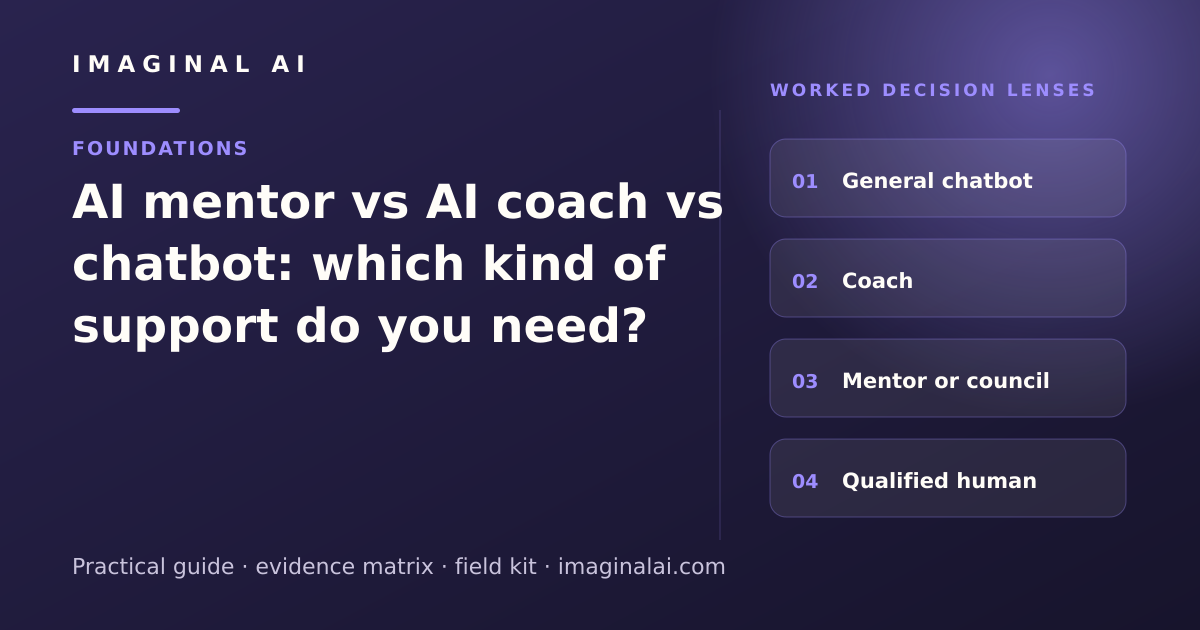
The labels overlap, but they describe different jobs. A chatbot is an interface, a coach usually structures reflection and accountability, and a mentor contributes a developed point of view or body of knowledge. Human advisors add lived experience, relationship, responsibility, and context that software cannot reproduce.
Choosing well begins with the task and its risk. The more a decision depends on regulated expertise, tacit organisational knowledge, or personal safety, the more important qualified human involvement becomes.
Start with the job, not the label
A general chatbot is useful when the task changes constantly: drafting, summarising, brainstorming, explaining, or transforming information. Its breadth is an advantage, but breadth does not create a dependable advisory identity. If a general assistant answers as a strategist in one turn and a therapist in the next, the user may not know which assumptions, qualifications, or sources are governing the response.
An AI coach is typically process-oriented. It asks questions, helps define an outcome, reflects language back to the user, tracks a commitment, and encourages review. An AI mentor is more content-oriented: it brings a recognisable framework, documented body of work, or specialised domain lens. A well-designed product can combine both, but it should tell the user which function is active.
Where source grounding changes the comparison
A persona prompt can make any general model imitate the surface style of a mentor. That is not the same as retrieval from an isolated corpus. Source grounding gives the system a bounded evidence set, allows citations, and makes insufficiency detectable. It also exposes the cost of the chosen boundary: a corpus may be historically rich but silent on a modern operational detail.
Coaching questions do not always require an external corpus, but factual or attributed mentor claims do. If an app says that a named thinker believed something, the user should be able to inspect the work and locator supporting that representation. Where the product is making a contemporary application, it should label the move as interpretation rather than silently placing new words in the mentor’s mouth.
Continuity and accountability
A single chatbot session can be helpful without becoming a system of support. Coaching and mentoring become more valuable when they preserve an objective, the current situation, previous advice, the user’s chosen action, and the result. Continuity makes it possible to notice a repeated avoidance pattern or recognise that the plan itself needs revision.
Accountability should remain user-controlled. Useful software can ask whether a commitment happened, diagnose a block, or offer to reschedule. It should not manufacture urgency, shame the user, or make hidden decisions on their behalf. Communication modes, quiet hours, channel preferences, and daily limits belong in the core design rather than in an afterthought settings page.
Human advisors remain a different category
A human mentor can notice posture, reputation, organisational politics, and contradictions that never reach a prompt. They can disclose their own failures, make introductions, stake their reputation, and accept responsibility for the relationship. A qualified professional can also apply regulated expertise and standards of care. Software cannot truthfully claim those qualities.
The most productive arrangement is often complementary. Use an AI system to prepare a brief, surface assumptions, compare frameworks, capture questions, and follow up between meetings. Bring the sharper brief to a human advisor. Record the decision and later use the system to review the outcome. This preserves human judgment while making the surrounding thinking more disciplined.
A selection matrix
Use a general chatbot for broad, low-risk transformation and exploration. Use an AI coach when you mainly need questions, structure, and follow-through. Use a source-grounded AI mentor when a documented lens or corpus is directly relevant. Use a multi-mentor council when the decision contains competing functions or values. Use a qualified human professional when the matter is regulated, safety-critical, irreversible, or dependent on facts the system cannot verify.
Whatever category you choose, inspect privacy, source handling, deletion, and commercial incentives. Ask what information is retained, whether private files train public systems, how citations are produced, and what happens when evidence is missing. The product’s answer to those operational questions is often more revealing than its best demonstration conversation.
Worked example · Illustrative scenario
Selection lab: match the support model to the job
A product leader is preparing for a difficult reorganisation. She needs to clarify her thinking, understand documented management ideas, draft communications, and involve an employment specialist where legal duties may be engaged.
| Lens | Question | Evidence to inspect | Effect on the decision |
|---|---|---|---|
| General chatbot | Is the work broad transformation rather than advice? | Drafting, summarising, restructuring notes, and generating low-risk alternatives. | Use it to prepare material, but do not treat fluency as attributed expertise. |
| Coach | Does the leader mainly need reflection and accountability? | Questions that clarify goals, choices, ownership, and patterns without supplying a doctrine. | Use coaching to improve the leader’s process and preserve autonomy. |
| Mentor or council | Would a documented lens change the analysis? | Traceable frameworks, distinct roles, independent answers, and visible disagreement. | Use a grounded council for organisation, incentives, communication, and ethical trade-offs. |
| Qualified human | Does the matter depend on law, safety, or tacit context? | Jurisdiction, employee circumstances, organisational politics, professional duty, and accountability. | Escalate employment-law and high-consequence people decisions to responsible humans. |
The leader uses a chatbot for document preparation, a coach for self-examination, a grounded council for competing management lenses, and an employment professional for legal and case-specific judgment. No single interface is asked to perform every job.
At the end of the process, record which category produced which contribution. If the same tool is repeatedly used outside its assigned boundary, redesign the workflow instead of relying on a disclaimer that nobody consults.
Free practical field kit · No signup required
Support-type selection matrix
Define the work before choosing a tool. This matrix separates broad assistance, reflective coaching, documented mentorship, multi-perspective counsel, and qualified human advice by the evidence and responsibility the situation requires.
- 01
Job to be done
Is the immediate need drafting, reflection, documented expertise, competing perspectives, accountability, or professional judgment?
- 02
Evidence requirement
Must claims trace to named sources, current facts, private context, regulated standards, or lived organisational knowledge?
- 03
Continuity requirement
What objective, decision history, commitment, or follow-up must persist beyond one conversation?
- 04
Risk and reversibility
What harm could follow from a wrong answer, and how easily could the resulting action be reversed?
- 05
Chosen support
Select chatbot, AI coach, grounded mentor, council, human adviser, or a deliberate combination—and state why.
Copy these prompts into your working document, or use your browser’s Print command to save this field kit as a PDF. The worksheet is available without an email gate.
Choose a support configuration →FAQ
Frequently asked questions
Is an AI coach better than an AI mentor?
Neither is universally better. Coaching is useful for process and self-directed reflection; mentoring is useful when a defined, traceable knowledge lens is needed.
When should I use a general chatbot?
Use one for broad, low-risk drafting, exploration, explanation, and transformation where a stable advisory identity is not necessary.
Can one product combine mentoring and coaching?
Yes, if it clearly distinguishes sourced mentor claims from coaching prompts, keeps the user in control, and preserves appropriate boundaries.
Sources and method
Trace the guide
This guide was developed with AI-assisted research and editorial tooling, then checked against Imaginal AI’s registered source maps, internal-link graph, and content-quality tests. Read the editorial standards, AI-assistance disclosure, and correction policy.
- What is an AI mentor?The product and trust definition used in this comparison.
- How corpus grounding worksWhy retrieval boundaries matter for attributed mentor answers.
- From counsel to commitmentThe action and follow-up layer that turns conversation into a learning loop.
- International Coaching Federation, 2025 Core CompetenciesThe current professional framework for coaching ethics, trust, communication, reflection, client autonomy, action, and accountability.
- NIST Artificial Intelligence Risk Management Framework 1.0Authoritative guidance for governing, mapping, measuring, and managing the risks of an AI system in its actual context of use.