Philosophy in practice
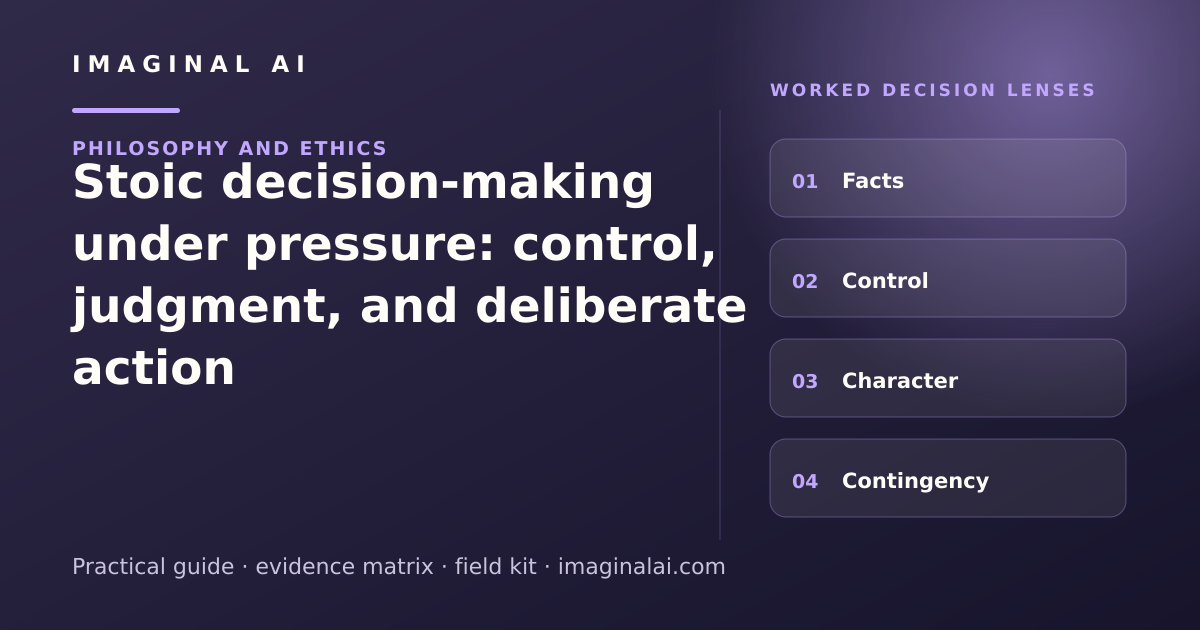
Stoic decision-making under pressure: control, judgment, and deliberate action
Apply Stoic distinctions to high-pressure decisions without confusing acceptance with passivity, suppressing emotion, or ignoring evidence and consequences.
Stoic practice can help a decision maker distinguish what depends on present judgment and action from what does not. That distinction is not a promise that outcomes can be controlled. It is a way to direct attention toward the quality of the choice, the conduct of the response, and the preparation for events that remain uncertain.
The method becomes distorted when “control what you can” is used to dismiss emotion, tolerate preventable harm, or avoid collective responsibility. A responsible application combines internal discipline with factual inquiry, ethical duty, contingency planning, and willingness to change course.
Draw the control boundary precisely
Write two columns. In the first, place judgments, intentions, communication, preparation, and actions that genuinely depend on you or the decision team. In the second, place market response, another person’s choice, past events, and outcomes that can be influenced but not commanded. Do not put organisational systems in the second column merely because they are difficult; authority and collective action can change some conditions.
The boundary reduces wasted effort, but it also assigns responsibility. If evidence gathering, consultation, or risk mitigation is available, those actions belong on the controllable side. Acceptance begins after the available duty has been identified, not before. The relevant question is “What is mine to do now?” rather than “How can I feel unaffected?”
Examine the impression before assent
Pressure compresses the distance between an event and the story told about it. Describe the event in observable terms before adding interpretation. A contract was cancelled; a forecast changed; a colleague criticised the plan. Then name the initial judgment—catastrophe, betrayal, humiliation, opportunity—and ask which evidence makes that interpretation more than an impression.
Create enough pause for choice without pretending that all decisions permit long reflection. A short protocol can work: facts, duty, options, downside, next action. Where time allows, bring a different council lens to challenge the first frame. The goal is not emotional numbness; it is to prevent the first charged narrative from becoming an unexamined command.
Use values as decision criteria
Stoic sources connect a good life with the quality of character and judgment, not simply preferred external results. Translate that idea into explicit criteria: honesty, justice, courage, self-command, and practical wisdom. Ask what each option requires you to become and whether the conduct would remain defensible if the outcome were unfavourable.
Values do not calculate the answer automatically. Duties can conflict, and an organisation affects people with different interests. Add stakeholder consequences, professional obligations, and specialist advice where required. The philosophical lens supplies questions about conduct; it does not replace legal, medical, financial, or technical expertise.
Rehearse adversity without feeding anxiety
Premeditating setbacks can reveal dependencies and contingencies. Imagine a small set of plausible adverse events, then ask what preparation is proportionate: cash reserve, communication plan, reversible pilot, stop condition, or alternate supplier. Convert each serious scenario into an action, trigger, or accepted risk.
Stop when rehearsal no longer changes preparation. Repeating vivid disaster without a new decision is rumination, not strategy. Return attention to the next controllable action and the information required to perform it. A bounded pre-mortem is useful precisely because it ends in ownership.
Review conduct and result separately
After the event, ask whether the team used the available evidence, acted consistently with its stated values, executed the plan, and responded to triggers. Then examine the result and new information. A fortunate outcome does not excuse reckless process, and an adverse outcome does not prove that the original judgment was poor.
Record where fear, status, haste, or attachment altered the decision. Also record where calm became detachment from another person’s legitimate concern. Stoic practice improves through repeated examination of judgments and conduct; it should make responsibility sharper, not make the organisation less responsive.
Worked example · Illustrative scenario
Pressure lab: respond to a major customer cancellation
A company loses its largest customer one week before a board meeting. The founder feels humiliated, fears a wider collapse, and wants to announce an immediate restructuring before the causes and cash position are understood.
| Lens | Question | Evidence to inspect | Effect on the decision |
|---|---|---|---|
| Facts | What occurred before interpretation is added? | Contract terms, stated reasons, revenue exposure, cash timing, service history, and what remains unknown. | Separate the cancellation from the first catastrophic narrative. |
| Control | What genuinely depends on present judgment and action? | Customer conversation, cash model, staff communication, pipeline review, specialist advice, and meeting preparation. | Move available duties onto the action side of the boundary. |
| Character | Which conduct must remain defensible under pressure? | Honesty, fairness, courage, confidentiality, responsibility, and treatment of affected people. | Reject deceptive reassurance and impulsive blame even if they feel protective. |
| Contingency | Which adverse scenarios require preparation now? | Further churn, covenant pressure, staff departure, delayed pipeline, and decision triggers. | Prepare proportionate responses, then return attention to the next controllable action. |
The founder pauses irreversible announcements long enough to establish facts, consult accountable specialists, and build a short cash-and-communication plan. Stoic discipline governs conduct and attention; it does not determine legal, financial, or employment decisions.
When the immediate period has passed, assess whether the pause improved judgment, whether emotion carried useful information, and which preparation was missing. Do not evaluate the practice by whether the lost customer returned.
Free practical field kit · No signup required
Stoic pressure-decision card
Use this card to create a short pause between a difficult event and the first charged interpretation. It combines the Stoic control distinction with evidence, ethical duty, and proportionate preparation.
- 01
Observable event
Describe what happened without motive, catastrophe, praise, blame, or a prediction about the whole future.
- 02
Control boundary
Separate present judgment, intention, communication, preparation, and action from outcomes and other people’s choices.
- 03
Initial impression
Name the first story and emotion, the evidence supporting it, and at least one plausible alternative interpretation.
- 04
Duty and values
State what honesty, justice, courage, self-command, practical wisdom, and relevant professional duties require now.
- 05
Prepared action
Choose the next action, realistic adverse scenario, contingency, stop point for rumination, and later conduct review.
Copy these prompts into your working document, or use your browser’s Print command to save this field kit as a PDF. The worksheet is available without an email gate.
Bring composure to the mission →FAQ
Frequently asked questions
What is the Stoic dichotomy of control?
It distinguishes judgments, intentions, and actions that depend on us from outcomes and external events that do not. In organisations, the boundary must still account for real authority and collective action.
Does Stoicism mean suppressing emotion?
No. A practical use notices emotion and the judgment attached to it, then chooses a response. Denial can hide information and delay necessary support.
Can Stoicism be used for business decisions?
It can strengthen attention, conduct, and resilience, but it should be combined with evidence, stakeholder analysis, professional expertise, and review.
Sources and method
Trace the guide
This guide was developed with AI-assisted research and editorial tooling, then checked against primary or authoritative sources, Imaginal AI’s registered source maps, the internal-link graph, and automated content-quality tests. Read the editorial standards, AI-assistance disclosure, and correction policy.
- Epictetus, DiscoursesA registered source edition for the distinction between what depends on us and what does not.
- Marcus Aurelius, MeditationsA primary Stoic source on judgment, conduct, duty, and response to events.
- Seneca, Moral Letters to LuciliusA registered source edition on adversity, preparation, emotion, and philosophical practice.