Decision practice
How to keep a decision journal: a practical template for better judgment
Use a decision journal to record context, options, assumptions, confidence, dissent, triggers, and results without letting hindsight rewrite the choice.
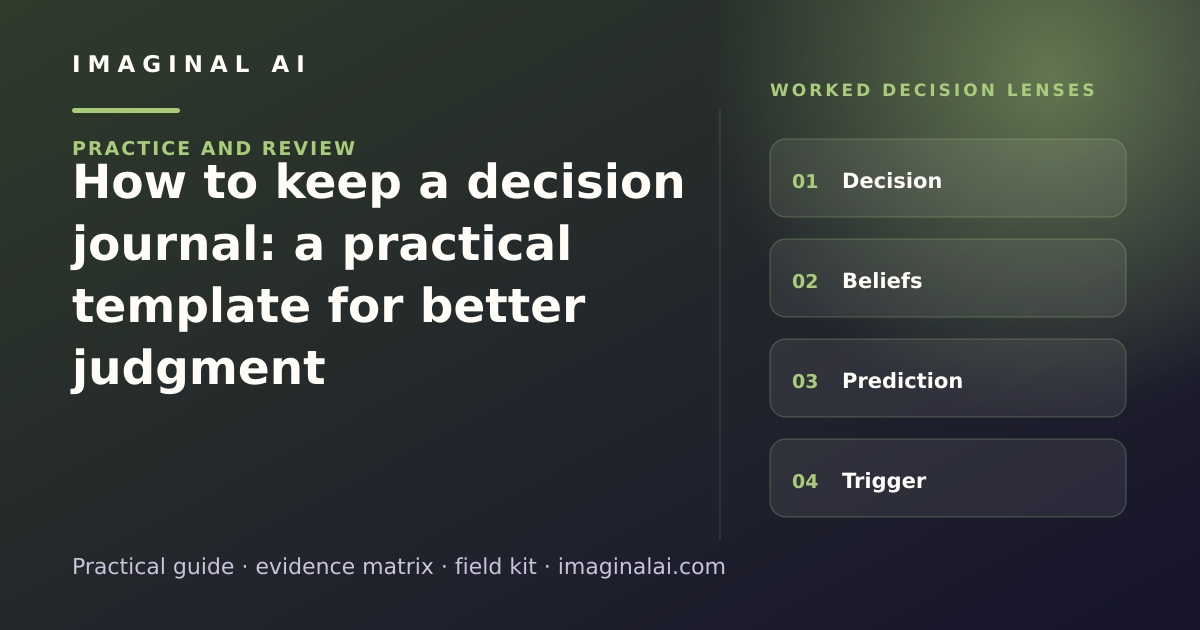
A decision journal preserves what you believed before the result was known. It records the choice, the alternatives, the evidence, the assumptions, the confidence level, and the conditions that would cause you to reconsider. That makes it possible to learn from judgment rather than merely react to outcomes.
The journal is not a diary and should not become an administrative burden. A useful entry is short enough to complete before action, specific enough to audit later, and honest about uncertainty. The template below is designed for business, leadership, and other consequential but repeatable decisions.
Define the decision boundary
Begin with one sentence that names the decision, the owner, and the latest useful decision date. Then describe what is inside and outside scope. “Choose a customer segment for the next two quarters” is reviewable; “decide our strategy” is not. State whether the decision is reversible, costly to reverse, or effectively irreversible, because that changes how much evidence and dissent it deserves.
Record the objective and the constraints separately. The objective says what improvement the choice should create. Constraints identify money, time, capability, law, ethics, commitments, or dependencies that rule out otherwise attractive options. If a constraint is only assumed, label it as an assumption. Teams often discover that an inherited constraint is actually a preference that can be renegotiated.
Capture the state of knowledge
Create five headings: known, estimated, assumed, disputed, and unknown. Put each material claim under one heading and name its source. This prevents a confident estimate from quietly becoming a fact as it moves through a deck. It also shows which uncertainty can be reduced through research and which depends on future events or another actor’s response.
Add a confidence range to the few variables that drive the choice. Avoid false precision. A range with a reason is more useful than a single number without provenance. Note what evidence would materially move the range. The purpose is not to quantify everything; it is to expose where the recommendation depends on a fragile belief.
Record options, dissent, and prediction
List at least three viable options when the stakes justify it, including the status quo or delay. For each option, record the mechanism by which it is expected to work, its opportunity cost, major downside, and a reason it might outperform the leading choice. This protects the journal from becoming a justification document written for an option selected in advance.
Write the strongest dissent in language its advocate would recognise. Then make a small number of falsifiable predictions: what should be observable, by what date, if the chosen mechanism is working? Give each prediction a confidence estimate. These numbers are not claims of scientific accuracy; they create a record from which calibration can improve.
Choose triggers and make the commitment
Define trigger conditions before implementation. A trigger might require more evidence, pause spending, change an operating plan, escalate to a specialist, or reopen the decision. Name the metric, threshold, owner, and response. A warning without a pre-agreed action is easy to rationalise away when sunk costs and organisational pride begin to accumulate.
Conclude with the choice, the trade-off accepted, and the first dated commitment. Record who owns execution and what evidence will be captured. If no option is yet supportable, make the evidence-gathering decision explicit instead of disguising delay as analysis. A decision to run a test is still a decision and should have a review date.
Review without hindsight
Schedule the review when the relevant signal should be mature. Reopen the original entry before discussing what happened. Compare predicted and actual evidence, then separate decision quality, execution quality, and external events. Do not lower a previous confidence estimate because the event failed to occur or claim that an unexpected result was obvious all along.
Finish by changing something operational: a future briefing field, evidence source, trigger, council role, estimate, or decision rule. Track calibration across similar predictions rather than judging yourself by one dramatic case. The value of the journal comes from the accumulated record, where recurring blind spots and reliable strengths become visible.
Worked example · Illustrative scenario
Journal example: record a hiring decision before the outcome
A founder must choose between an experienced candidate who can start immediately and a less experienced internal candidate with strong company knowledge. The role is important, evidence is incomplete, and personal preference is already shaping the discussion.
| Lens | Question | Evidence to inspect | Effect on the decision |
|---|---|---|---|
| Decision | What exactly is being chosen and by when? | Role outcome, owner, candidates considered, scope, reversibility, and latest useful date. | Prevent the review from drifting into a general judgment of either person. |
| Beliefs | Which claims are known, estimated, assumed, or disputed? | Work samples, references, context knowledge, ramp estimate, team needs, and evidence quality. | Attach confidence to the few beliefs that drive the choice. |
| Prediction | What should be observable if the choice is sound? | Thirty-, sixty-, and ninety-day outputs, relationship signals, decision quality, and support load. | Write forecasts before access to the outcome changes memory. |
| Trigger | What would require support, scope change, or reconsideration? | Missed milestone, role mismatch, resource gap, team harm, and responsible escalation path. | Make a response part of the trigger instead of recording a warning only. |
The founder records the chosen candidate, the trade-off accepted, confidence in the key assumptions, and a ninety-day support and review plan. The journal does not pretend the person can be reduced to a score.
At ninety days, compare the original predictions with evidence while separating selection quality, onboarding, role design, and external events. Change a future hiring question or process field, not merely the story told about this hire.
Free practical field kit · No signup required
Copy-ready decision journal template
Copy these five blocks into a document, task, or decision record before the outcome is known. Keep the entry proportional to the stakes and attach the original evidence rather than rewriting it later.
- 01
Header
Decision; owner; objective; latest useful date; scope; constraints; reversibility; cost of delay; review date.
- 02
State of knowledge
Known; estimated; assumed; disputed; unknown; evidence source; confidence range; information still worth buying.
- 03
Options and prediction
Viable options; status quo; mechanism; opportunity cost; major downside; strongest dissent; observable predictions; confidence.
- 04
Choice and triggers
Chosen option; accepted trade-off; first commitment; owner; due date; success signal; pause, stop, or escalation thresholds.
- 05
Review
Actual result; prediction accuracy; decision quality; execution quality; external events; surprise; calibration; changed rule or process.
Copy these prompts into your working document, or use your browser’s Print command to save this field kit as a PDF. The worksheet is available without an email gate.
Open a decision mission →FAQ
Frequently asked questions
What should a decision journal include?
Include the decision and owner, objective, constraints, options, evidence, assumptions, unknowns, dissent, predictions, confidence, triggers, commitment, and review date.
How long should a decision journal entry be?
Use the shortest entry that preserves the important reasoning. A routine reversible choice may need a few lines; an irreversible strategic decision may need several pages and attachments.
Is a decision journal the same as an after-action review?
No. The journal records thinking before the outcome. The after-action review compares that original record with what happened and changes the future process.
Sources and method
Trace the guide
This guide was developed with AI-assisted research and editorial tooling, then checked against primary or authoritative sources, Imaginal AI’s registered source maps, the internal-link graph, and automated content-quality tests. Read the editorial standards, AI-assistance disclosure, and correction policy.
- HM Treasury, The Green Book 2026Authoritative guidance on objectives, options, evidence, uncertainty, appraisal, monitoring, and evaluation.
- William James, The Principles of Psychology, Volume IA registered source edition used as a historical lens on attention, belief, and judgment.
- Imaginal AI after-action review guideThe outcome and process review that closes the journal loop.