Trust and rights
Source rights and provenance for AI mentor corpora
See how edition records, territorial rights, translation review, checksums, source attestations, private uploads, and deletion gates work.
A mentor corpus is not safe to use merely because the author is old, a scan is online, or a United States repository labels a work public domain. The exact edition, translation, transcription, territory, and intended use all matter.
Imaginal AI treats rights and provenance as release data. A document must pass the source gate before indexing, and a production build requires an owner attestation for every eligible edition and launch territory.
Register the exact source
Each source record identifies the mentor, named work, provider, edition or ebook ID, original publication year, translation-review requirement, rights status, and reason when blocked. Local sources also identify the author name used in the verified corpus and the territories covered by the existing ledger.
This prevents a title-level assumption from authorising an unknown file. Two editions of the same ancient work can have different translators and different rights. A modern introduction, notes, or transcription may remain protected even when the underlying original is ancient.
Separate territorial determinations
Project Gutenberg’s copyright work is centred on United States law, and its own guidance warns that a book’s status may differ elsewhere. Imaginal AI’s launch review requires both US and GB. A Gutenberg preflight can support a staging build, but it is not automatically a production approval for every territory.
The registry therefore distinguishes cleared, preflight-passed, and blocked. Production refuses preflight-only sources without a separate owner attestation covering the required territories. This is a product safety gate, not a legal conclusion generated by the application.
Treat translations as independent works
For translated philosophy, strategy, and literature, the original author’s dates do not settle the English edition. The translator’s work may have its own term. The source record explicitly marks whether translation review is required, and the production attestation must apply to the exact text being imported.
Where a reliable English transcription or translator-rights basis cannot be verified, the mentor remains blocked even if demand is high. A profile may describe a registered source plan honestly, but the app must not present live grounded retrieval until an eligible edition has been built, imported, and queried successfully.
Make the corpus reproducible
The builder downloads or reads only registered providers, verifies expected source markers, strips repository envelopes, chunks the body deterministically, and writes mentor-specific NDJSON. Every bundle records source and output checksums, document counts, environment, engine ID, rights status, and required territories.
A second verifier reads every document and rejects missing metadata, duplicate IDs, cross-mentor contamination, empty text, checksum drift, and preflight-only rights in a production release. Blocked mentor IDs must be absent from the release manifest. These controls make it possible to reproduce what entered an index.
Keep private corpora private
Custom mentor files are a different product path. The user attests that they own or may process the documents; uploads go to a user-scoped storage path and private index namespace. Server rules require ownership for reads and writes. Private text is never used to create public mentor pages, resource articles, or another user’s retrieval results.
Deletion must reach identity, database records, stored objects, OAuth credentials, and private search namespaces. A deletion queue and worker make that multi-system process observable and retryable. Public source records remain separate because they belong to the platform’s release inventory, not the user’s account.
Use honest public language
A source map, a built bundle, an imported data store, and a verified live engine are different states. Public pages should name the state accurately. “Registered works” means titles have been mapped. “Staging corpus built” means documents and audits exist. “Live retrieval” requires successful import and a verified search in the target environment.
The same discipline applies to citations. A generated answer should expose the passage actually retrieved, not merely list a plausible book. Rights governance and response grounding meet at that point: the citation proves which approved document the runtime used and allows the reader to inspect the context.
Worked example · Illustrative scenario
Provenance lab: decide whether one historical edition may enter production
A source registry contains an English translation of an ancient philosophical work found in a United States public-domain repository. The product is intended for users in both the United States and United Kingdom.
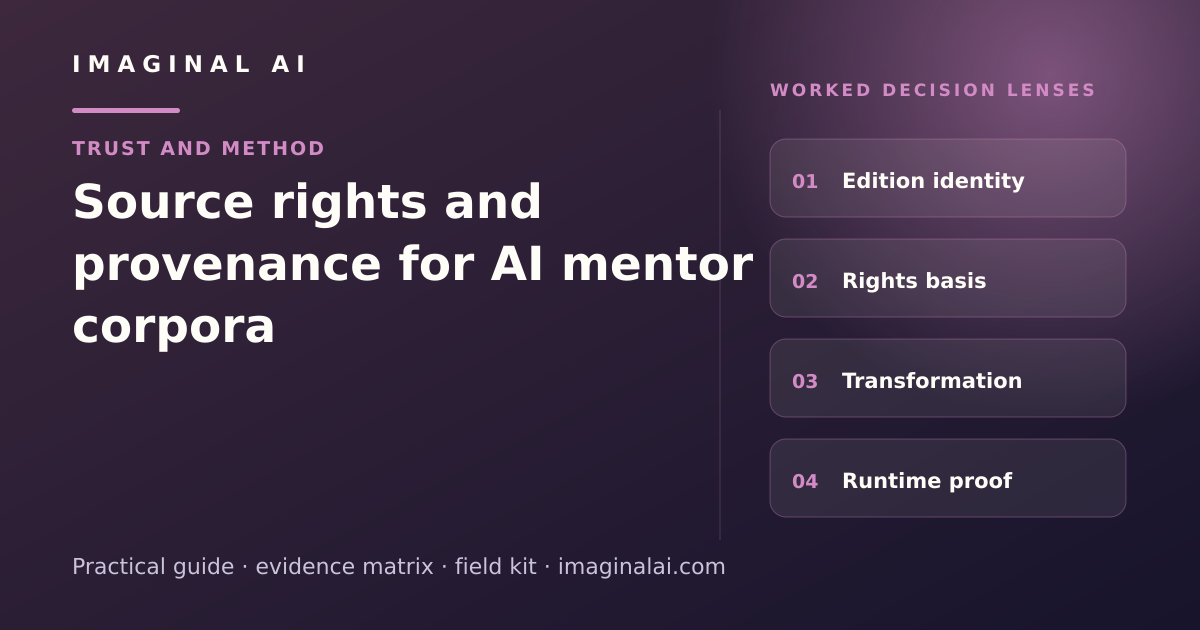
| Lens | Question | Evidence to inspect | Effect on the decision |
|---|---|---|---|
| Edition identity | What exact object will be processed? | Author, title, translator, editor, publisher, date, source URL, checksum, and stable local record. | Block an import that identifies only the ancient original. |
| Rights basis | Why may this edition be used in each territory? | Country-specific term analysis, translation status, licence terms, trademark conditions, and counsel where needed. | Treat a US repository record as evidence, not automatic worldwide clearance. |
| Transformation | What enters the corpus and how? | Downloaded bytes, removed envelopes, normalisation, chunking rules, locators, and output checksums. | Make the built bundle reproducible from the approved input. |
| Runtime proof | Can production retrieve only approved documents? | Environment, data store, engine, mentor ID, document count, sample query, and citation readback. | Do not describe a registered source as live until import and retrieval succeed. |
The edition remains blocked until translation and territorial status are attested for the actual file. Product demand, author age, or successful staging ingestion cannot substitute for a documented production rights decision.
Recheck the source when territory, provider terms, edition, file checksum, or product use changes. Preserve the previous determination so an updated source cannot silently inherit approval from a different object.
Free practical field kit · No signup required
AI corpus provenance release checklist
Use this checklist for every work before it enters a public mentor corpus. It distinguishes bibliographic identification, territorial analysis, technical reproducibility, runtime status, and private-data handling.
- 01
Exact edition
Record title, author, translator, editor, publication details, provider URL, file checksum, transcription, and source locator.
- 02
Rights and territories
Document the basis for every launch territory, restrictions, licence terms, trademarks, and reviewer or owner attestation.
- 03
Translation and additions
Review the translation, introduction, notes, illustrations, formatting, and later editorial material as separate contributions.
- 04
Reproducible corpus
Record cleaning rules, chunking version, metadata schema, output checksums, mentor ID, data store, engine, and import result.
- 05
Release and deletion state
Distinguish registered, built, imported, query-verified, production-released, blocked, and private-deletion responsibilities.
Copy these prompts into your working document, or use your browser’s Print command to save this field kit as a PDF. The worksheet is available without an email gate.
Inspect the mentor registry →FAQ
Frequently asked questions
Is every Project Gutenberg book public domain worldwide?
No. Project Gutenberg’s determination is focused on the United States, and status can differ in other countries. Territorial review is still required.
Why do translations need separate review?
A translation is a creative work with its own rights even when the underlying original is ancient or otherwise public domain.
Do private custom mentor files become public content?
No. They remain user-scoped and are excluded from public mentor corpora and SEO generation.
Sources and method
Trace the guide
This guide was developed with AI-assisted research and editorial tooling, then checked against Imaginal AI’s registered source maps, internal-link graph, and content-quality tests. Read the editorial standards, AI-assistance disclosure, and correction policy.
- Project Gutenberg copyright guidanceRepository explanation of its United States copyright analysis and user responsibilities.
- Project Gutenberg licenceTerms attached to Project Gutenberg files and trademark language.
- UK National Archives: copyright and related rightsGeneral United Kingdom copyright-term context used during territorial preflight.