Economic reasoning
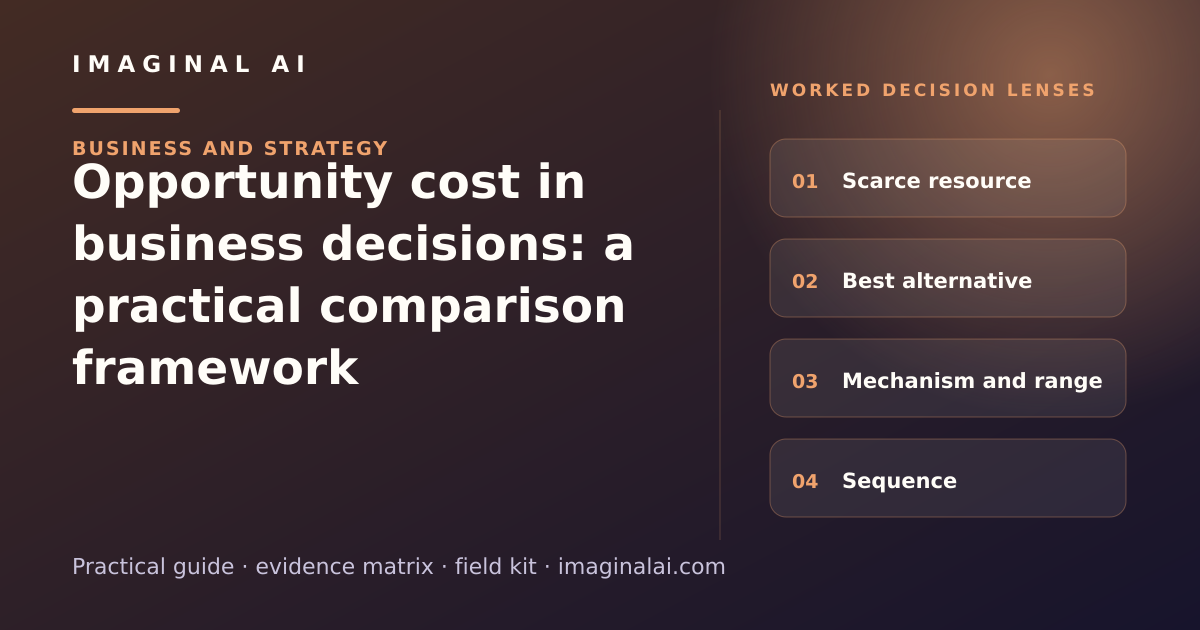
Opportunity cost in business decisions: a practical comparison framework
Compare the next-best use of money, time, attention, people, and strategic position instead of treating the visible price as the full cost of a choice.
Opportunity cost is the value of the best available alternative forgone when a resource is committed. The resource may be cash, but it may also be founder attention, engineering capacity, trust, option value, market position, or the ability to respond later. A proposal can be affordable and still be expensive in opportunity terms.
The comparison is forward-looking. Sunk costs explain the current position but do not make continued investment valuable. A practical framework names the objective, generates real alternatives, compares their full consequences over the same horizon, and preserves uncertainty rather than forcing every consideration into one financial number.
Name the scarce resource and objective
State what is actually constrained: capital, a specialist team, leadership attention, calendar time, customer trust, regulatory capacity, or another asset. Then define the objective the allocation is supposed to advance. Without a shared objective, two options can appear comparable while solving different problems.
Choose a time horizon long enough to include implementation, operation, and exit or renewal. A cheaper short-term option may create expensive switching or maintenance later. A long horizon should not imply certainty; use ranges and scenario conditions where future costs and benefits are materially uncertain.
Generate feasible alternatives
Include business as usual and at least one materially different way to meet the objective. Avoid filling the list with cosmetic variations around a favoured proposal. Ask what the same people and money could achieve elsewhere and what would happen if the decision were delayed. The next-best alternative must be feasible, not an imaginary perfect use.
Separate options that can be combined from those that are mutually exclusive. Record dependencies and sequencing. A small pilot may preserve the option to scale, while a platform migration may close alternatives for years. Option value can justify a path that produces less immediate return but better information or flexibility.
Compare full resource use
For each option, list direct expenditure, operating cost, internal time, displacement of other work, learning curve, coordination load, switching cost, and exit liability. Treat already-paid resources according to their next-best future use. An employee’s salary is sunk for the current period, but assigning their next month still has an opportunity cost.
Add benefits and harms that are important but not credibly monetisable. Customer trust, staff capability, resilience, strategic fit, and distributional effects should remain visible in the comparison rather than receive invented prices. Summary metrics can inform judgment without becoming the judgment.
Test uncertainty and switching values
Identify the few assumptions that determine the ranking. Vary them through realistic ranges and ask where the preferred option changes. A switching value answers a concrete question: how low must adoption be, how long can delivery slip, or how high can operating cost rise before another option becomes preferable?
Consider asymmetric downside and reversibility. Two options with similar expected value can differ sharply if one creates an unrecoverable commitment. Record risk appetite and mitigation cost. Do not hide a severe tail risk inside an average whose inputs no one can defend.
Make allocation and review explicit
Write the chosen option and the alternative being forgone. Naming the sacrifice improves strategic honesty and makes later reprioritisation easier. Assign owners, budget, capacity, success measures, and stop conditions. If a resource has not actually been released from its previous commitment, the new plan is not funded.
Review whether the expected opportunity cost materialised. Did displaced work matter more or less than expected? Did the chosen path create capability or lock-in? Update the organisation’s estimates and allocation rules. Opportunity cost becomes useful when it changes real commitments, not when it appears as a definition in the opening slide.
Worked example · Illustrative scenario
Allocation lab: compare a new product with the strongest foregone alternative
A company can fund either a new adjacent product or a reliability programme for its growing core service. The new product has visible revenue upside; the reliability work protects retention and operating capacity but is harder to celebrate.
| Lens | Question | Evidence to inspect | Effect on the decision |
|---|---|---|---|
| Scarce resource | What capacity can only be used once? | Senior engineering time, product attention, capital, customer trust, and organisational change capacity. | Name the binding constraint before comparing headline benefits. |
| Best alternative | What is the strongest feasible use of that capacity? | Reliability outcomes, retained revenue, reduced incidents, option value, and timing. | Compare the new product with an operationally specified alternative, not “do nothing.” |
| Mechanism and range | How does each option create value under uncertainty? | Causal path, evidence, ranges, dependencies, downside, and response by customers or competitors. | Expose which forecast depends on more fragile assumptions. |
| Sequence | Can one option preserve access to the other? | Delay cost, reversibility, learning stage, dependency removal, and decision gates. | Consider reliability work that unlocks a lower-risk product test later. |
Leadership funds a bounded reliability stage and defines the conditions for reopening the adjacent-product investment. The choice is justified by the value of retained customers, reduced operating drag, and preserved future option—not by a claim that maintenance is inherently safer.
Track the foregone alternative as seriously as the chosen work. At the gate, update both cases with new evidence so opportunity cost remains a living comparison rather than a paragraph written once for approval.
Free practical field kit · No signup required
Opportunity-cost comparison sheet
Use this sheet when several attractive options compete for the same scarce resource. It compares what each choice consumes, displaces, preserves, and makes harder to reverse.
- 01
Scarce resource and objective
Name the constrained money, time, attention, capacity, reputation, or option value and the outcome it should serve.
- 02
Feasible alternatives
List credible uses of the resource, including the status quo, staged options, combinations, and a deliberate wait.
- 03
Full resource use
For each option, include direct cost, management attention, dependencies, displaced work, switching friction, and residual capacity.
- 04
Uncertainty and switching value
Record ranges, learning value, reversibility, time to evidence, break-even assumptions, and the next-best alternative.
- 05
Allocation decision
State the chosen option, opportunity cost accepted, owner, first commitment, review signal, and reallocation trigger.
Copy these prompts into your working document, or use your browser’s Print command to save this field kit as a PDF. The worksheet is available without an email gate.
Compare allocations with a council →FAQ
Frequently asked questions
What is opportunity cost in a business decision?
It is the value of the best feasible alternative forgone when money, time, people, attention, capacity, or strategic flexibility is committed to a choice.
Is opportunity cost the same as price?
No. Price is one visible expenditure. Opportunity cost includes what the committed resources could have produced in their next-best use.
Should sunk costs be included in opportunity cost?
Past unrecoverable costs should not determine the forward choice, but resources already acquired can still have a future alternative use that creates an opportunity cost.
Sources and method
Trace the guide
This guide was developed with AI-assisted research and editorial tooling, then checked against primary or authoritative sources, Imaginal AI’s registered source maps, the internal-link graph, and automated content-quality tests. Read the editorial standards, AI-assistance disclosure, and correction policy.
- HM Treasury, The Green Book 2026Current authoritative guidance on options, opportunity cost, sunk cost, uncertainty, and balanced appraisal.
- Adam Smith, The Wealth of NationsA primary source on allocation, specialisation, incentives, exchange, and productive capacity.
- Frédéric Bastiat, Essays on Political EconomyA primary economic source associated with examining visible and less visible consequences.